For multinational corporations operating in India, a sweeping overhaul of the country’s employment law landscape demands immediate strategic planning. The consolidation of 29 fragmented central labor laws into 4 comprehensive labor codes—specifically the Code on Wages, 2019 and the Code on Social Security, 2020—introduces a standardized legal framework for employee compensation and statutory social security benefits.
Failing to re-engineer your local salary structures, miscalculating adjusted statutory allowances, or delaying corporate provisions for expanded employee benefits can lead to heavy retroactive compliance liabilities, severe administrative penalties under provincial labor departments, and significant financial strain on corporate reserves. For C-suite executives, HR directors, and general counsels, a granular restructuring of local payroll economics is an urgent operational requirement to maintain compliance with India’s modernized labor policies.
Key Structural Adjustments in India’s Compensation Architecture
| Regulatory Metric | Historic Framework (Pre-Reform) | New Labour Code Framework | Corporate Financial Impact |
|---|---|---|---|
| Statutory “Wages” Definition | Variable and highly fragmented across states | Capped at a uniform 50% of gross remuneration | Higher baseline for statutory calculations |
| Provident Fund (PF) Contribution | Assessed on basic salary + DA (often <50% of gross) | Assessed on new expanded “wages” definition | Increased monthly cash outflow for employer |
| Gratuity Liability Accumulation | Calculated on narrower base; 5-year vesting rule | Calculated on 50% minimum base; continuous tracking | Expanded balance-sheet provisioning required |
Core Regulatory Pitfalls and Strategic Insights
1. Navigating the Unified 50% Cap on Allowances and the Expanded Definition of Wages
The operational centerpiece of India’s labor law reform is the introduction of a singular, standardized definition for “Wages” across all four codes. Historically, corporations minimized their statutory liabilities by restructuring compensation packages to feature a low basic salary coupled with highly inflated allowances (such as house rent, travel, and special allowances) that routinely accounted for 60% to 70% of an employee’s gross remuneration.
Under the new Code on Wages, all excluded allowances collectively cannot exceed 50% of the total gross remuneration. If the sum of these allowances surpasses this 50% threshold, the excess amount is automatically added back to the statutory wage base. This structural shift legally forces companies to ensure that an employee’s basic salary plus specified inclusions equals at least 50% of their total cost-to-company (CTC), instantly inflating the baseline used for social security obligations.
2. Restructuring Provident Fund Contributions under Elevated Baseline Calculations
The redefinition of the statutory wage base directly impacts the monthly cash outflows for Employee Provident Fund (EPF) contributions under the Code on Social Security. Traditionally, employers calculated the mandatory 12% PF contribution on a restricted definition of basic wages.
With the 50% minimum wage cap strictly enforced, the absolute value of the wage baseline will scale upward for a significant percentage of white-collar and corporate workforces. Consequently, the employer’s matching 12% contribution will increase proportionally, driving up total workforce overhead costs even if an employee’s gross CTC remains unchanged. Corporate chief financial officers must run comprehensive payroll simulations to absorb these heightened structural costs without eroding net corporate profitability.
3. Managing Expanded Gratuity Provisions and Balance-Sheet Re-evaluation
Gratuity payments, governed under the new social security framework, are facing a double-layered compliance adjustment. Because gratuity is legally calculated based on 15 days of statutory wages for every completed year of service, the expansion of the “wages” definition directly elevates both current payouts and long-term actuarial provisions.
Furthermore, the codes introduce flexible nuances regarding vesting periods—particularly for fixed-term contract employees who may now qualify for pro-rata gratuity without fulfilling the traditional 5-year continuous service benchmark. Corporate legal teams must rapidly coordinate with licensed actuaries to recalculate long-term gratuity liabilities and adjust balance-sheet reserves to prevent severe under-funding penalties during subsequent corporate audits.
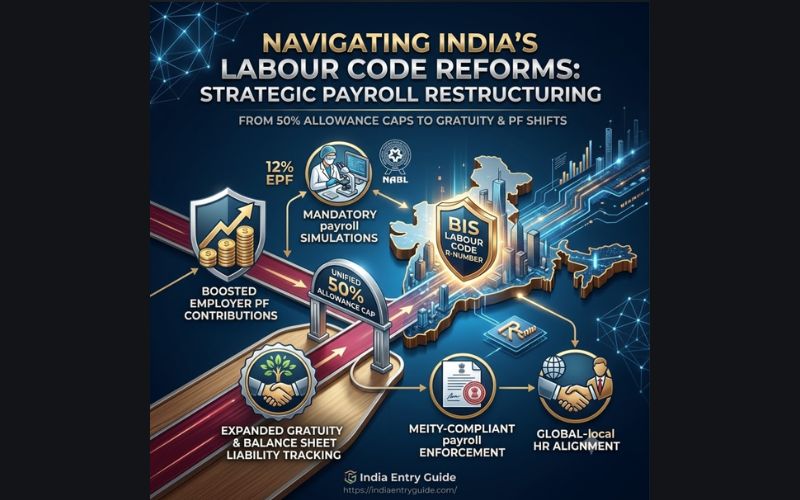
🗺️ Visual Data Summary: Navigating India’s Labour Code Shift
To help C-level executives streamline human resource and payroll adaptations, our platform has mapped the core components of the New Labour Codes transition in India. Below is the structural breakdown of the localized financial and HR touchpoints required to safeguard your corporate compliance:
- 50% Salary Restructuring Matrix: Automated auditing of local payroll software to cap allowances at exactly 50% of gross CTC, automatically rebalancing basic salary baselines.
- Provident Fund (PF) Outflow Scaling: Strategic financial forecasting to absorb increased 12% employer matching contributions under the expanded statutory wage criteria.
- Actuarial Gratuity Provisioning: Direct recalculation of long-term corporate termination liabilities to account for heightened wage baselines and pro-rata fixed-term allowances.
- Fixed-Term Workforce Integration: Onboarding flexible labor structures into centralized payroll systems to guarantee compliant social security payouts and avoid localized labor disputes.
- State-Level Rule Alignment: Continuous tracking of individual state government gazette notifications to align implementation timelines across different manufacturing or corporate office hubs.
Strategic Verdict & Actionable Advice
- Execute Immediate Payroll Audits: Run a full-scale payroll simulation across your entire Indian workforce to isolate the exact percentage of employees whose allowances exceed the 50% threshold. Immediate adjustments will prevent unexpected cash flow shocks upon final enforcement.
- Review and Update Actuarial Assumptions: Engage your external auditing partners to revise long-term gratuity valuation models. Adjusting your balance-sheet provisions progressively prevents sudden, large-scale adjustments to your local operating margins.
📞 CONTACT US
- India HQ : +91 99807 56389
- Seoul Liaison : +82 10-7641-4018
- Email : liminae@adullamcorp.com
- Website : https://adlconsulting.in/
Copyright 2026. India Entry Guide. All rights reserved.