For multinational logistics operators and manufacturing enterprises shipping raw materials and finished goods into India, operational velocity at the port of entry determines profit margins. The Central Board of Indirect Taxes and Customs (CBIC) has systematically overhauled its national customs gateway—the Indian Customs Electronic Gateway, or ICEGATE—introducing mandatory digital filing frameworks to accelerate freight processing.
Failing to align your cross-border documentation with these real-time electronic upgrades can lead to immediate demurrage charges, prolonged container detention by local port authorities, or red-channel audits that disrupt time-sensitive supply chains. For C-suite executives, supply chain directors, and customs brokers, executing a flawless, synchronized compliance workflow on the updated ICEGATE portal is a core operational requirement to eliminate port clearance bottlenecks.
Key Operational Metrics for Modernized ICEGATE Filings
| Compliance Parameter | Historic Workflow Protocol | Modernized ICEGATE Protocol | Immediate Supply Chain Benefit |
|---|---|---|---|
| Bill of Entry (BoE) Timeline | Filed upon or after cargo vessel arrival | Mandatory advance filing 24-48 hours prior | Prioritized green-channel routing |
| Document Verification | Manual ledger assessment at local customs desk | Automated AI-driven faceless assessment | Eliminates regional bureaucratic friction |
| Duty Payment Infrastructure | Fragmented offline banking transactions | Integrated e-Sanchit electronic wallet | Immediate, automated clear-to-release status |
Core Regulatory Pitfalls and Strategic Insights
1. Transitioning to Mandatory Advance Bill of Entry (BoE) Mandates
The most significant operational shift enforced by the CBIC is the strict timeline adjustment for filing the Bill of Entry (BoE). Under the current Customs Act mandates, importers must submit the electronic BoE via the ICEGATE portal before the end of the calendar day preceding the day on which the vessel or aircraft carrying the goods arrives at the customs station.
This regulatory acceleration means that manual, retrospective documentation is no longer tolerated. Attempting to file a BoE post-arrival triggers automatic statutory late-filing fines per day under Section 46 of the Customs Act, while simultaneously pushing the shipment to the bottom of the verification queue. Logistics teams must coordinate seamlessly with overseas shipping lines to secure the Manifest/Bill of Lading data early, allowing your local customs broker to execute the advance ICEGATE filing flawlessly.
2. Navigating the Faceless Assessment Architecture to Bypass Regional Grievances
To eliminate localized corruption and standardize customs valuation, the CBIC has completely uncoupled physical cargo location from the legal assessment process through its Faceless Assessment initiative. Under this digital ecosystem, when an advance BoE is filed on ICEGATE, the portal’s automated risk management engine assigns the dossier to a Virtual Assessment Group (VAG) located anywhere in India, completely anonymous to the importer.
While this prevents regional bureaucratic friction, it introduces a new challenge: your technical documentation must be utterly unambiguous. If a virtual officer in another state flags a valuation query or a product classification mismatch under the Harmonized System (HS) code, clarification requests (Queries) are issued purely through ICEGATE. Importers must monitor the portal continuously and respond with comprehensive technical datasheets within hours; failure to respond promptly locks the container in place, triggering catastrophic port-side storage overheads.
3. Optimizing Digital Document Uploads via the e-Sanchit Gateway
The administrative backbone of zero-delay port clearance is the e-Sanchit (Electronic Storage and Retrieval of Domestic Documents) component integrated into the ICEGATE architecture. This system completely replaces physical document submission with digital, cryptographically signed uploads of supporting invoices, packing lists, and mandatory central agency clearances—such as BIS certificates or food safety permits.
A critical pitfall occurs when customs brokers upload low-resolution or incorrectly formatted PDFs, which are immediately rejected by the automated validation scripts. To avoid processing stalls, compliance teams must establish strict digital standards: every supporting document must be converted into a machine-readable, high-fidelity format, uploaded to generate an official Document Reference Number (DRN), and correctly linked to the main electronic BoE before the cargo makes landfall.
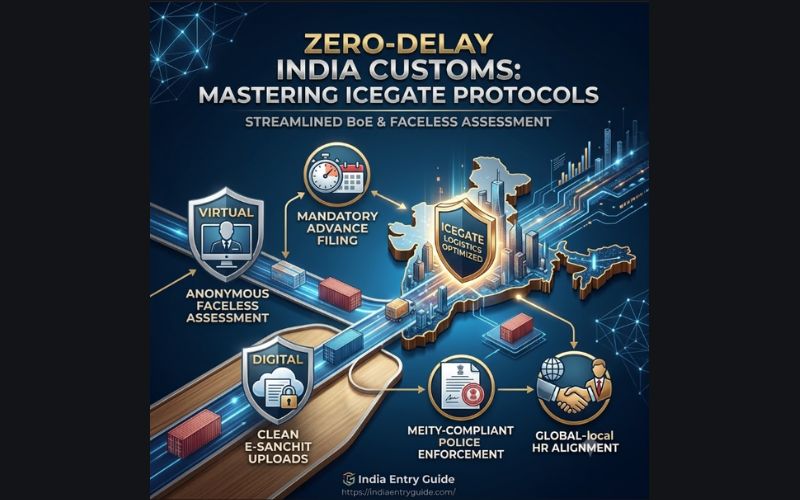
🗺️ Visual Data Summary: Navigating India’s CBIC Logistics Map
To help C-level executives streamline shipping operations and bypass customs barriers, our platform has mapped the core components of a modernized ICEGATE filing. Below is the structural breakdown of the localized digital and physical touchpoints required to accelerate your port clearance:
- Advance BoE Timeline Integration: Automated triggers ensuring that all import documentation is uploaded 24 to 48 hours before port arrival to lock in preferential clearing slots.
- Faceless Assessment Portal Routing: Centralized management of HS code classifications and valuation proof to achieve instant, query-free approval from virtual CBIC assessment groups.
- e-Sanchit Digital Dossier Optimization: Systematic uploading of clean, high-resolution certificates (BIS, EPR, Phyto-sanitary) to secure immediate, automated Document Reference Numbers (DRN).
- Integrated e-Payment Portals: Direct ledger linking with ICEGATE electronic payment systems to execute instant customs duty settlements, mitigating bank-processing delays.
- Green-Channel Logistics Alignment: Coordinating with authorized economic operators (AEO) to leverage expedited container releases once the electronic customs seal is approved.
Strategic Verdict & Actionable Advice
- Enforce an Internal 48-Hour Document Rule: Mandate that all overseas suppliers provide finalized commercial invoices and packing lists at least 48 hours before the cargo vessel arrives in Indian waters. This guarantees your local broker has the buffer required to process an advance BoE smoothly.
- Secure Authorized Economic Operator (AEO) Status: If your enterprise manages consistent, high-volume import-export cycles in India, invest the resources to achieve AEO tier certification. This status unlocks fast-track green-channel processing on ICEGATE, significantly minimizing the probability of random physical cargo examinations.
📞 CONTACT US
- India HQ : +91 99807 56389
- Seoul Liaison : +82 10-7641-4018
- Email : liminae@adullamcorp.com
- Website : https://adlconsulting.in/
Copyright 2026. India Entry Guide. All rights reserved.