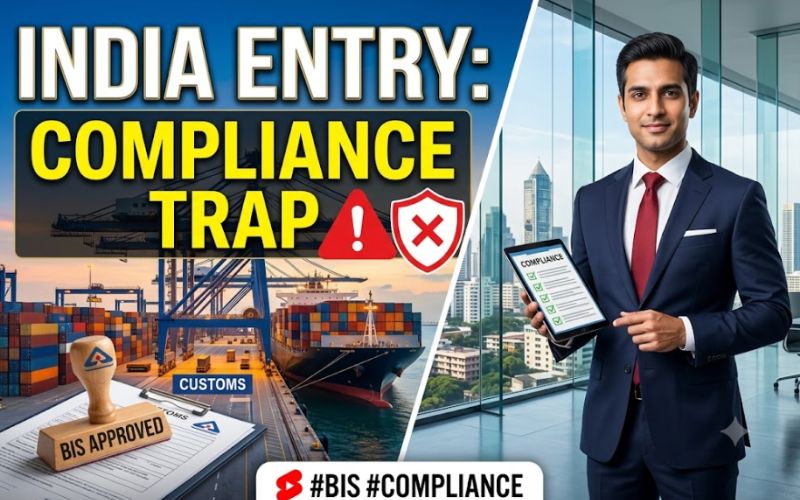
Entering the Indian market—a massive consumer ecosystem of 1.4 billion people—presents an unparalleled growth opportunity for multinational enterprises. However, many global founders, CFOs, and investment teams are often blindsided by the highly complex, localized bureaucratic framework. Navigating Indian regulatory compliance demands a proactive strategy rather than reactive troubleshooting.
Without key pre-entry approvals, most notably the Bureau of Indian Standards (BIS) certification, international goods will face immediate seizure or rejection at Indian customs entry ports. Furthermore, failing to align early-stage capitalization with banking regulations can stall legal operations before they even begin. This guide breaks down the critical compliance pillars required to safeguard your investments and successfully cross the regulatory starting line.
📊 Visual Data Card: Indian Entry Compliance Checklist
- The BIS Certification Gatekeeper – Mandatory quality stamps are strictly required before goods hit the customs port; without it, shipping assets face complete seizure.
- The Banking Capitulation Trap – Failing to structure the initial equity capital under strict FEMA guidelines will result in complete account activation freezes.
- The Local Incorporation Shield – Navigating India’s administrative layers demands a localized regulatory blueprint across RBI and MCA protocols.
🔍 Deep-Dive Analysis: Neutralizing Regulatory Traps in India
1. The Mandatory Gatekeeper: Bureau of Indian Standards (BIS) Certification
Under the Bureau of Indian Standards Act, 2016, and various Quality Control Orders (QCOs) issued by the Ministry of Commerce and Industry, the Indian government mandates technical compliance for a vast range of products. This is not a voluntary quality seal; it is a rigid import gatekeeper.
If an enterprise imports electronics, solar equipment, steel, chemicals, or automotive components without securing an active BIS Registration or ISI Mark, the goods are instantly flagged. Retrospective certification while containers are stalled at Indian ports is practically impossible, leading to catastrophic storage fees, regulatory penalties, and a complete supply chain freeze.
2. The Capital Structure Trap & FEMA Non-Compliance
Setting up local operations in India is intrinsically tied to strict cross-border transaction controls monitored by the Reserve Bank of India (RBI). When foreign parent companies inject initial capital into their new local subsidiary, the funds must be treated carefully.
Under the Foreign Exchange Management Act (FEMA) guidelines, foreign investments must enter as designated foreign direct investment (FDI) share capital and be reported correctly on the RBI’s FIRMS portal (via Form FC-GPR) within 30 days. Initiating local banking operations with unstructured transfers will cause banks to freeze accounts, making it impossible to pay local vendors, secure commercial leases, or clear administrative payroll.
📋 India Entry Structure & Governance Matrix
| Compliance Dimension | Governing Authority | Key Legal Framework / Act | Direct Operational Impact on Entry |
|---|---|---|---|
| Product Certification | Bureau of Indian Standards (BIS) | BIS Act, 2016 / Quality Control Orders | Mandatory testing and factory audits required prior to port arrival. |
| Capital & FX Inflow | Reserve Bank of India (RBI) | Foreign Exchange Management Act (FEMA) | Strict reporting of initial FDI; failure blocks corporate bank operations. |
| Entity Incorporation | Ministry of Corporate Affairs (MCA) | Companies Act, 2013 | Regulates the formal setup of a Wholly Owned Subsidiary (WOS). |
💡 Strategic Verdict & Actionable Advice for the Boardroom
- Initiate BIS Auditing 6 Months Pre-Shipping: Ensure all technical and product compliance audits are initiated directly with certified Indian testing labs before any cargo is loaded.
- Employ an Authorized Indian Representative (AIR): Foreign manufacturers must legally appoint an AIR within India to manage the local registration, testing, and submission workflows with the BIS.
- Run Parallel FEMA-Compliant Banking Setup: Coordinate with a designated Authorized Dealer Category-I (AD Bank) in India to structure your capital injection path in absolute alignment with RBI expectations.
📞 CONTACT US
- India HQ : +91 99807 56389
- Seoul Liaison : +82 10-7641-4018
- Email : liminae@adullamcorp.com
- Website : https://adlconsulting.in/
- YouTube : https://www.youtube.com/@indiabizgateway
Copyright 2026. India Entry Guide. All rights reserved.