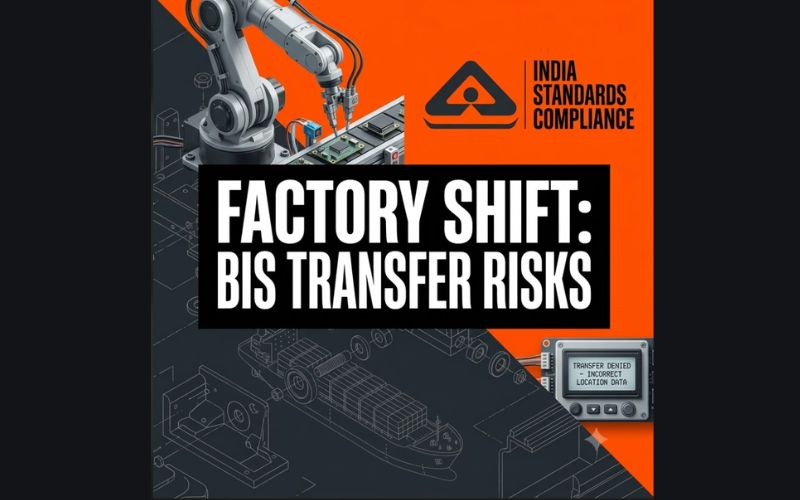
For global corporate development officers, multinational legal counsels, and cross-border supply chain directors, the structural realignment of manufacturing footprints toward India offers an unprecedented market expansion opportunity. However, executing a seamless cross-border asset migration requires navigating a complex regulatory maze. A catastrophic compliance friction point frequently overlooked by M&A teams and manufacturing executives during a “China+1” transition is the strict legal non-transferability of product safety registrations. Corporations operating under the flawed assumption that existing machinery calibrations and technical test records can be seamlessly mapped or amended to a new geographic point-of-origin face immediate legal exposure at the Indian customs frontier.
Under the domestic manufacturing and import framework, the Bureau of Indian Standards (BIS) evaluates conformity based on localized manufacturing point-of-origin. When production lines cross sovereign borders into India’s industrial corridors, legacy foreign certifications are immediately invalidated. Failing to establish an independent, parallel domestic compliance track prior to decommissioning legacy plants creates extensive supply chain deadlocks, high-tariff border detentions, and significant operational friction.
📊 Visual Data Card: The BIS Certification Transfer Compliance Runway
- The Geographic Co-ordinate Mandate: A BIS registration or license is legally anchored to a specific physical factory address, not a corporate entity, brand trademark, or parent holding structure.
- The Structural Void Risk: Relocating previously validated machinery, surface-mount technology (SMT) lines, or tooling from an overseas plant to an Indian facility completely voids the legacy foreign certification.
- The Dual-Track Solution Vector: Corporate compliance frameworks must deploy a proactive, parallel testing architecture 6 months prior to legacy facility decommissioning to eliminate market-supply gaps.
- Regulatory Enforcement Oversight: Importing uncertified electronics or industrial components under an invalid or legacy address constitutes a direct violation of the BIS Act, 2016 and the Customs Act, 1962.
🔍 Deep-Dive Analysis: Neutralizing Factory Relocation Risks
1. Defining the Geographic Boundary of Product Certification
The invocation of localized manufacturing mandates hinges upon whether the Bureau of Indian Standards (BIS) and the Ministry of Electronics and Information Technology (MeitY) classify the point of production as a new facility. Under the BIS (Conformity Assessment) Regulations, 2018, a license to apply a standard mark is plant-specific.
- It requires independent, physical verification of the machinery setup at the exact geographic coordinates registered.
- It results directly in the cancellation of import validity if manufacturing operations at the legacy plant cease.
- It lacks any legal mechanism for cross-border address amendments or multi-facility generic licensing.
- It is entered into and audited based on the specialized local infrastructure, local testing personnel, and localized internal quality control (IQC) frameworks.
Crucially, the burden of proof under Indian regulatory jurisprudence places the onus heavily on the brand owner to demonstrate that the new factory footprint mirrors identical quality control guidelines.
2. Corporate Structure Transitions: Shifting to Indian Contract Manufacturers (EMS)
A common operational vulnerability for multinational corporations entering India is migrating assembly from an overseas facility to a domestic Electronic Manufacturing Services (EMS) provider. When utilizing a local contract manufacturer, the foreign brand owner cannot reuse its existing foreign factory BIS license.
If the intermediate manufacturing footprint lacks a distinct registration paired specifically with that local EMS plant, customs officials will classify the incoming component kits (CKD/SKD formats) as non-compliant inventory. This immediately triggers administrative seizures and structural fines under the Directorate General of Foreign Trade (DGFT) import guidelines.
3. Legacy Test Report Rejection and the Re-Testing Mandate
Historically, global firms expected that test reports generated by internationally accredited labs (such as ILAC or IECEE CB schemes) could be used to fast-track the BIS Certification Transfer process. However, under the Compulsory Registration Scheme (CRS) and the Foreign Manufacturers Certification Scheme (FMCS), the BIS enforces strict data sovereignty. All product samples must undergo physical extraction and destructive testing within BIS-recognized laboratories located domestically inside India. Legacy test data from decommissioned overseas facilities is legally inadmissible for localized factory applications.
🗺️ Indian BIS Structure & Governance Matrix
| Governance Dimension | Primary Legal Mechanism | Mandated Operational Clause | Primary Risk Vector |
|---|---|---|---|
| Physical Line Relocation | BIS (Conformity Assessment) Regulations, 2018 | Complete factory re-testing and fresh CRS application filing. | Supply chain blackout due to immediate voiding of legacy foreign certificates. |
| Local EMS Outsourcing | MeitY Smart Device Safety Guidelines | Tripartite Quality Agreements and new localized AIR legal execution. | Misaligned product marking leading to asset seizure under the Customs Act. |
| Parallel Plant Expansion | BIS Act, 2016 Section 13 / 14 | Distinct registration sequences for duplicate manufacturing units. | Cross-contamination of batches leading to systemic domestic product recalls. |
| CKD/SKD Kit Importation | DGFT Foreign Trade Policy Framework | Component-level verification for pre-assembled sub-modules. | Classification as uncertified electronics, triggering 100% tariff penalties. |
🎴 [Quick Slide] 3-Minute Executive Card News
🃏 Card 1: Beyond Corporate Structures (The Factory Address Filter)
- Executive Summary: Successful Indian market entry requires robust, verifiable localized factory compliance. Look past superficial corporate registrations.
- Operational Check: Audit internal asset registries to confirm that every operational BIS license maps to the exact physical coordinates of your active assembly line.
🃏 Card 2: The Cross-Border Transfer Myth (The Location Rule)
- Executive Summary: Relocating validated equipment across borders does not preserve certification status. The BIS framework treats every new site as a fresh risk.
- Operational Check: Verify if your M&A or supply chain transition plans have allocated budget and a 180-day window for complete domestic re-testing.
🃏 Card 3: Neutralizing Transactional Taints (The Localized Testing Moat)
- Executive Summary: Cross-border manufacturing shifts must strictly mirror domestic testing mandates. Legacy foreign lab data cannot bypass Indian laboratory validation.
- Operational Check: Secure priority queue testing slots with BIS-recognized labs in India before dismantling legacy international production lines.
🃏 Card 4: Pre-Wiring the Audit Trail (The Defense Gateway)
- Executive Summary: Compliance disputes at Indian ports are increasingly resolved through direct legal liability tracking via the Authorized Indian Representative (AIR).
- Operational Check: Compile contemporaneous economic agreements and clarify joint-and-several legal liabilities with your chosen AIR prior to shipping initial batches.
📋 Strategic Verdict & Actionable Advice for the Boardroom
- Enforce a Mandatory Pre-Relocation BIS Assessment: Institutionalize an independent regulatory review before any physical asset transfer occurs, ensuring that target facility footprints match the stringent compliance guidelines of the FEMA rules and the Ministry of Consumer Affairs.
- Retain Direct Parental Governance Over Substance Documentation: Do not outsource the Authorized Indian Representative designation carelessly to third-party distributors or unverified local entities. Maintain structured control through an established local subsidiary or an independent legal custodian to insulate corporate officers from operational compliance liabilities.
📞 CONTACT US
- India HQ : +91 99807 56389
- Seoul Liaison : +82 10-7641-4018
- Email : liminae@adullamcorp.com
- Website : https://adlconsulting.in/
Copyright 2026. India Entry Guide. All rights reserved.