For multinational electronics brands and hardware startups eyeing India’s massive consumer electronics market, regulatory approval is the absolute gatekeeper to market entry. Under the Bureau of Indian Standards Act, 2016, the Ministry of Electronics and Information Technology (MeitY) mandates that specific categories of electronic and IT products comply with rigorous standard conformance protocols before cross-border customs clearance. This regulatory enforcement is managed through the Compulsory Registration Scheme (CRS).
Failing to secure proper certification from the Bureau of Indian Standards (BIS) can lead to shipments being permanently impounded at customs checkpoints by the Central Board of Indirect Taxes and Customs (CBIC), severe fiscal penalties, or the complete blacklisting of your corporate entity. For C-suite executives and compliance officers, evaluating the technical and operational roadmap of BIS CRS validation is a critical prerequisite before shipping commercial hardware to India.
Key Regulatory Frameworks for Electronics Compliance
| Product Category | Core Regulatory Scheme | Governing Standard | Mandatory Testing Requirement |
|---|---|---|---|
| IT Equipment & Laptops | BIS CRS Scheme | IS 13252 (Part 1) | In-Country ILAC/NABL Lab Testing |
| Lithium-Ion Batteries | BIS CRS Scheme | IS 16046 (Part 1 & 2) | Cell & Pack Level Separate Testing |
| Smartphones & Wearables | BIS CRS Scheme | IS 13252 / IS 16333 | Safety & Language Font Conformance |
Core Regulatory Pitfalls and Strategic Insights
1. Executing Mandatory In-Country Testing via NABL Accredited Laboratories
The foundational bottleneck for foreign electronics exporters under the BIS CRS framework is the restriction on overseas laboratory documentation. Unlike European CE marking or American FCC declarations, which often accept self-certification or third-party reports from global testing houses, the BIS CRS scheme strictly mandates physical, in-country testing within India.
All product samples must be dispatched to and tested by laboratories accredited by the National Accreditation Board for Testing and Calibration Laboratories (NABL) and officially recognized by BIS. The testing evaluation scrutinizes critical safety parameters, including thermal insulation, electrical shock vulnerabilities, and overall build durability under Indian voltage fluctuations. Overseas manufacturing plants must proactively integrate this testing lead time into their global product launch calendars to avoid major supply chain disruptions.
2. Appointing an Authorized Indian Representative (AIR) for Cross-Border Legal Liability
Foreign manufacturers who do not maintain a physical corporate presence or a registered liaison office within the borders of India cannot apply for BIS certification directly. To bridge this regulatory gap, the Bureau of Indian Standards mandates the formal appointment of an Authorized Indian Representative (AIR).
The AIR functions as the local legal proxy for the foreign manufacturer and must be a resident Indian citizen or a legally incorporated domestic entity. Crucially, the AIR assumes joint legal and financial liability for the long-term market compliance of the certified electronics. Should a product line exhibit manufacturing defects or fail random market surveillance audits, Indian regulatory authorities will initiate legal proceedings against the registered AIR. Therefore, selecting an experienced corporate compliance firm to serve as your AIR is vital to protecting your brand equity.
3. Navigating the Multi-Tiered Factory Audit and Market Surveillance Ecosystem
Obtaining the initial BIS registration number (R-Number) does not signal the end of your corporate compliance obligations. The BIS CRS framework utilizes a continuous, multi-tiered enforcement approach that includes robust post-market surveillance.
While initial CRS registrations generally bypass physical overseas factory inspections, the BIS retains the legal statutory right to conduct unannounced factory audits to verify quality control continuity. Furthermore, the regulatory body executes routine retail market surveillance, where enforcement officers purchase certified electronic items directly from Indian retail shelves or e-commerce platforms like Amazon India or Flipkart. These surveillance samples are routed back to NABL labs to verify they perfectly match the original test specifications. Any material deviation will result in the immediate suspension or cancellation of your product’s R-Number.
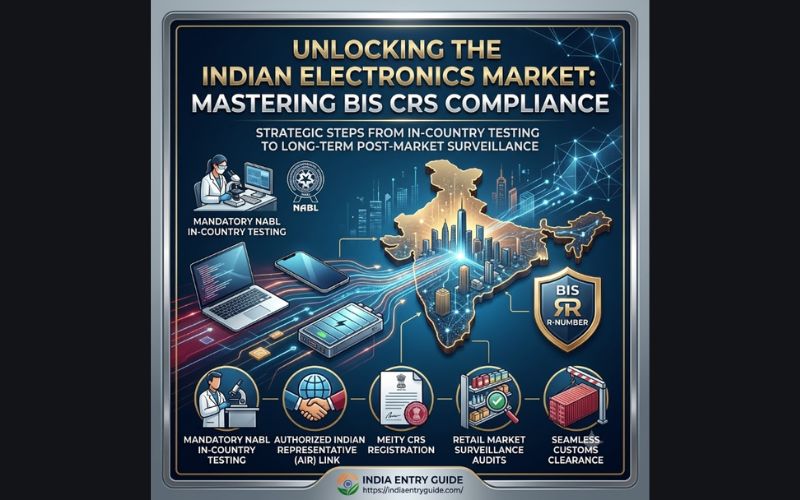
🗺️ Visual Data Summary: Navigating India’s BIS Compliance Map
To help C-level executives streamline the regulatory onboarding pipeline, our platform has mapped the core components of a successful BIS CRS hardware deployment in India. Below is the structural breakdown of the localized testing, legal, and factory touchpoints required to maximize regulatory compliance:
- In-Country Sample Logistics: Strict tracking of prototype sample shipments routed directly through NABL-accredited facilities to secure compliant safety reports.
- Authorized Indian Representative (AIR) Integration: Formal legal anchoring linking foreign manufacturing operations with a domestic proxy to handle local regulatory enforcement.
- Key Certification Streams & Standards:
- IS 13252: Primary safety benchmarks governing power adapters, servers, and main computing hardware.
- IS 16046: Double-layered cell and pack isolation compliance protocols for lithium-ion storage units.
- Post-Market Surveillance Audits: Strategic planning for localized retail product pulls and ongoing factory manufacturing alignment to preserve your active R-Number status.
- Customs Clearance Sync: Proper alignment of factory-stamped BIS labels on all outer packaging to facilitate rapid clearing at CBIC ports of entry.
Strategic Verdict & Actionable Advice
- Execute Separate Cell and Pack Testing: When certified hardware utilizes lithium batteries, ensure that the individual cells are BIS-certified before submitting the complete battery pack for testing. Dual tracking cuts your total testing timeline in half.
- Audit Your AIR’s Compliance Infrastructure: Never appoint a temporary logistics partner or distributor as your AIR. Utilizing an independent, professional corporate compliance firm prevents your intellectual property and certification data from being held hostage during commercial disputes with local distributors.
📞 CONTACT US
- India HQ : +91 99807 56389
- Seoul Liaison : +82 10-7641-4018
- Email : liminae@adullamcorp.com
- Website : https://adlconsulting.in/
Copyright 2026. India Entry Guide. All rights reserved.