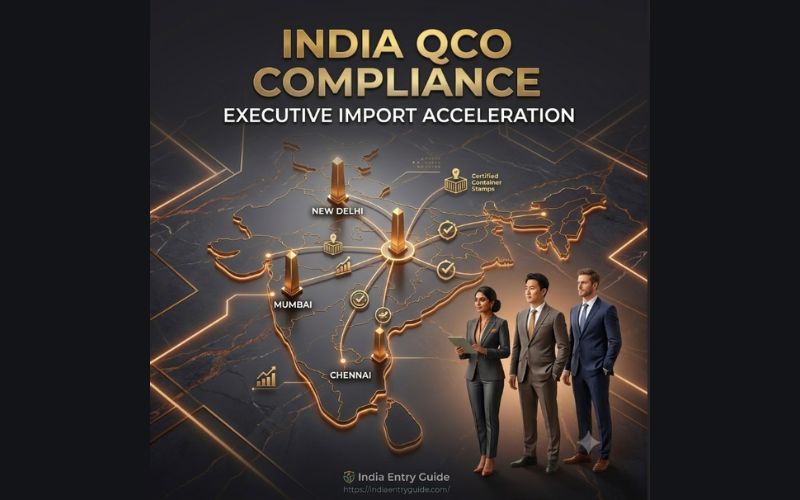
For international brands and global supply chain executives, expanding commercial footprints into India requires navigating an increasingly complex regulatory framework. While tariff structures and custom duties have traditionally been the primary focus of trade optimization desks, non-tariff barriers have now taken center stage. The most significant of these shifts is the aggressive enforcement of Quality Control Orders (QCOs) issued by various ministries under the statutory framework of the Bureau of Indian Standards (BIS).
QCOs are mandatory compliance edicts that restrict the import, sale, or distribution of goods within the Indian market unless they carry the official BIS standard mark. For global manufacturing units, ignoring the operational impact of a newly enacted QCO is a critical failure vector, leading to immediate supply chain paralysis, high-volume customs detentions at major ports like Mumbai or Chennai, and compounding demurrage costs. This comprehensive playbook breaks down how to strategically audit and navigate India’s escalating QCO framework.
🗺️ Visual Data Card: The QCO Compliance Lifecycle
To help global operational headers map out this intense regulatory journey, we have consolidated the mandatory core phases of the QCO compliance timeline below. Use this visual summary to track factory readiness along with your regulatory task force:
- Phase 1: Tariff Line Auditing — Cross-referencing product Harmonized System (HS) codes against active and upcoming Ministry-specific QCO notifications.
- Phase 2: Localized Lab Pipeline — Shipping physical component samples to certified domestic laboratories within India for strict, destructive engineering evaluations.
- Phase 3: Statutory Factory Audits — Coordinating on-site factory inspections by Indian regulatory officials to verify end-to-end quality management systems (QMS).
- Phase 4: Mandatory CRS/ISI Stamp Deployment — Formally mapping the certified registration numbers onto production lines prior to global container breaking and shipping runs.
Deep-Dive Analysis: The Mechanics of Quality Control Orders
1. Deciphering the Shift from Voluntary to Mandatory Standards
Historically, many standards published by the Bureau of Indian Standards functioned as voluntary guidelines to assist domestic industrial alignment. However, through the systematic issuance of Quality Control Orders (QCOs) by key central ministries—such as the Ministry of Commerce and Industry and the Ministry of Electronics and Information Technology (MeitY)—hundreds of industrial and consumer goods categories have been placed under strict statutory mandates.
Once a QCO is officially notified in the Gazette of India, the transition window is unforgiving. No foreign manufacturer can legally export products under that specific tariff line to India without securing a formal BIS license first. This legal barrier applies universally, regardless of whether your product already meets mature international quality benchmarks like CE, ISO, or FCC. Under Indian law, international certifications cannot be used as a substitute for an explicit QCO compliance certificate.
2. Navigating the Double Gate: Destructive Sample Testing & Physical Factory Audits
Securing compliance under a QCO mandate is divided into two highly demanding operational components. First, foreign entities must navigate localized product testing protocols. Your engineering teams must physically ship sample units to designated National Accreditation Board for Testing and Calibration Laboratories (NABL) facilities inside India. These samples undergo rigorous evaluation under localized climate and operational tolerances.
Second, depending on whether the product falls under the Compulsory Registration Scheme (CRS) or the legacy ISI marking scheme, the QCO structure may require an official Indian inspector to physically visit your overseas manufacturing plant. During this factory audit, the inspector evaluates your raw material sourcing channels, local testing equipment calibrations, and the competency of your assembly line quality control personnel. Any discrepancy between your internal standard operating procedures (SOPs) and the mandated Indian Standards (IS) will result in immediate application deferrals.
3. Strategic Integration into the 2026 Supply Chain Calendar
The leading cause of product launch delays for multinational brands entering India is treating QCO alignment as a secondary logistical checklist item. Given the compounding backlogs at domestic testing labs and the administrative coordination required to schedule international auditor travel, the typical lead time to clear a new QCO pipeline can range anywhere from three to six months.
Furthermore, global supply chain directors must recognize that QCO enforcement applies strictly to the date of entry at Indian customs, not the date the ship departed the home port. If a container arrives at the Port of Nhava Sheva even one day after a mandatory QCO takes effect, and the cargo lacks the official BIS stamp, the entire shipment is legally prohibited from entering the country. It cannot be retroactively stamped or reworked inside a bonded warehouse; it faces mandatory re-export or immediate destruction.
📊 QCO Framework & Operational Workflow Matrix
| Regulatory Layer | Primary Governing Entity | Core Compliance Requirement | Cross-Border Supply Chain Risk |
|---|---|---|---|
| Gazette Notification | Central Line Ministries | Mandated adherence to specific IS codes | Instant market lockout upon enforcement date |
| Domestic NABL Testing | Empaneled Indian Laboratories | Physical, localized sample evaluation | Long testing queues causing component expiration |
| On-Site Factory Audit | BIS Directorate Officials | Physical verification of plant QA/QC | Delays in scheduling international auditor travel |
| Customs Border Check | Central Board of Indirect Taxes | Verification of valid BIS license matching HS codes | Complete cargo seizure and compounding demurrage |
Strategic Verdict & Actionable Advice for the Boardroom
- Establish a Proactive Regulatory Radar: Do not wait for a QCO to become legally active. Instruct your corporate legal desk to actively monitor draft QCO notifications submitted by India to the World Trade Organization (WTO) Technical Barriers to Trade (TBT) committee. This grants your factory an early 6 to 12-month engineering window to re-align component pipelines.
- Secure an Independent Authorized Indian Representative (AIR): Because QCO compliance requires a legally accountable local liaison residing in India, avoid assigning the AIR title to a commercial distributor. If an exclusive distributor holds your compliance certificate, your brand effectively loses the flexibility to expand sales networks or switch logistics partners. Maintain full ownership of your BIS license through an independent entity layout.
📞 CONTACT US
- India HQ : +91 99807 56389
- Seoul Liaison : +82 10-7641-4018
- Email : liminae@adullamcorp.com
- Website : https://adlconsulting.in/
Copyright 2026. India Entry Guide. All rights reserved.