For multinational corporations, tax compliance and structured fiscal mapping are foundational to scaling long-term profitability in India. As the country secures its position as a primary global manufacturing and services hub, the Ministry of Finance has streamlined its direct tax architecture. However, navigating the core corporate tax rates requires a granular breakdown of available statutory regimes, localized surcharges, and the compounding mechanics of the Minimum Alternate Tax (MAT).
For financial directors, C-suite planners, and investment compliance boards, optimizing your fiscal footprints under the Income-tax Act requires evaluating whether to opt for legacy tax tracks with standard deductions or to migrate to newer, exemption-free concession regimes. This executive playbook breaks down India’s corporate fiscal environment for 2026.
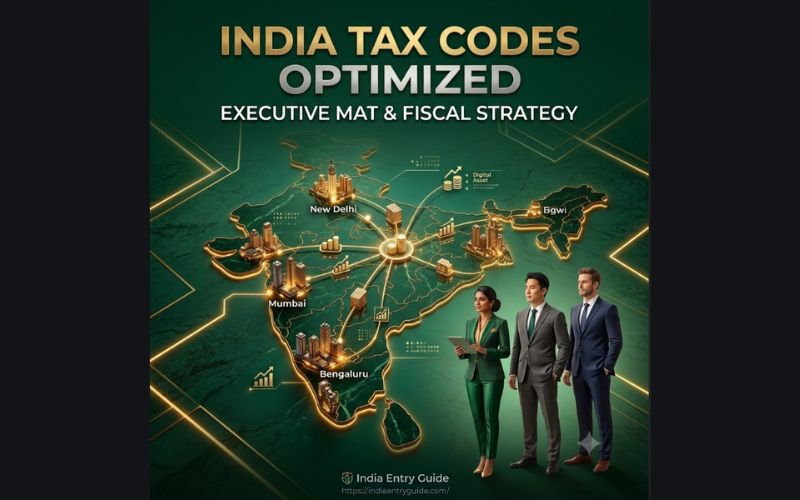
🗺️ Visual Data Card: The 2026 India Corporate Tax Framework
To help financial planning desks map out their fiscal strategies, we have consolidated the core pillars of India’s corporate tax structure below. Use this breakdown to audit your subsidiary’s tax exposure alongside your local accounting desk:
- Pillar 1: Section 115BAA Track — A modernized, concessionary base corporate tax rate of 22% available to domestic companies, provided they opt out of specific tax incentives and deductions.
- Pillar 2: The Legacy Regime Alternative — Higher base tax tiers (ranging from 25% to 30%) that preserve access to valuable accelerated depreciation, localized investment allowances, and area-based exemptions.
- Pillar 3: The MAT Safety Net — A 15% statutory minimum levy assessed on “book profits” designed to ensure that profitable entities utilizing extensive deductions still contribute a baseline fiscal share.
- Pillar 4: Layered Surcharges & Cess — Progressive surcharges applied to the base liability based on total corporate income brackets, rounded off by a mandatory 4% Health and Education Cess.
Deep-Dive Analysis: Regimes, MAT, and Surcharge Mechanics
1. Evaluating the Direct Tax Fork: Section 115BAA vs. Legacy Regimes
The most critical choice an expanding international corporation must make upon local incorporation is selecting its permanent direct tax path. Under Section 115BAA, domestic companies can opt for a flat base corporate tax rate of 22%. When combined with the mandatory 10% standardized surcharge and the 4% education cess, the effective tax rate settles at a highly competitive 25.17%. The catch is that companies choosing this concessionary track must permanently forfeit access to specialized deductions, such as sector-specific investment allowances or accelerated research and development write-offs.
Conversely, foreign subsidiaries that rely heavily on upfront capital expenditures or operate within specific Special Economic Zones (SEZs) may find it more advantageous to remain under the Legacy Tax Regime. Under this track, smaller domestic entities or companies with specific turnovers face base rates of 25%, while larger entities default to 30%. While these base numbers are higher, they preserve your legal right to deploy historical deductions to minimize net taxable income during early, capital-intensive manufacturing runs.
2. Decoding the Minimum Alternate Tax (MAT) Safeguard
For corporate boards remaining under the legacy incentive-heavy tax track, their fiscal planning must constantly account for Section 115JB, universally known as the Minimum Alternate Tax (MAT). MAT was specifically enacted as a statutory safety net to target “zero-tax companies”—entities that report robust commercial net profits to shareholders but leverage complex legal deductions to declare near-zero taxable income to the revenue authority.
Under the current framework, if a company’s normal corporate income tax liability falls below 15% of its audited “book profits”, the book profit value is legally treated as the taxable base, and a 15% statutory minimum tax is levied. However, companies subject to MAT can accumulate MAT Credits—representing the difference between the MAT paid and their normal calculated tax liability. These credits can be carried forward for up to 15 fiscal years to offset normal corporate tax liabilities in future periods when the factory scales into steady operational profitability. Note: Companies that formally transition to the concessionary Section 115BAA regime are entirely exempt from MAT assessments.
3. Unpacking the Progressive Surcharge Architecture for Foreign Entities
Calculating corporate tax liability in India requires applying a multi-tiered surcharge structure that scales directly with overall corporate net income brackets. Surcharges do not apply to the raw corporate revenue, but act as a compounding multiplier on top of the calculated base tax liability. Furthermore, India maintains a distinct statutory separation between domestic incorporated subsidiaries and registered Foreign Companies (such as Project Offices or Branch Offices).
For domestic corporations operating under the legacy track, surcharges are assessed at 7% for net incomes between INR 10 million and INR 100 million, scaling up to 12% when net income breaches the INR 100 million threshold. For registered Foreign Companies, the surcharge is legislated at a lower base—2% for incomes between INR 10 million and INR 100 million, and 5% for incomes exceeding INR 100 million—to balance out the higher base tax rate of 40% typically assessed on un-incorporated foreign business branches.
📊 Corporate Tax Matrix & Effective Rate Breakdown
| Entity Profile & Chosen Regime | Base Tax Rate | Applicable Surcharge Tier | Effective Tax Rate (Incl. Cess) | MAT Applicability |
|---|---|---|---|---|
| Domestic Co. (Sec. 115BAA) | 22% | Flat 10% (All Income Tiers) | 25.17% | Fully Exempt |
| Domestic Co. (Legacy < 100M INR) | 25% / 30% | 7% Surcharge | 28.60% / 34.32% | Subject to 15% Base MAT |
| Domestic Co. (Legacy > 100M INR) | 25% / 30% | 12% Surcharge | 29.12% / 34.94% | Subject to 15% Base MAT |
| Foreign Company (> 100M INR) | 40% | 5% Surcharge | 43.68% | Subject to 15% Base MAT |
🗺️ Strategic Verdict & Actionable Advice for the Boardroom
- Run a Multi-Year Parallel Simulation: Before locking your newly incorporated Indian subsidiary into the Section 115BAA track, instruct your tax desk to model a 5-year simulation comparing the flat 25.17% rate against the legacy track utilizing accelerated capital allowances and MAT credits. Once Section 115BAA is activated, it cannot be revoked.
- Monitor the 4% Compounding Cess Barrier: Ensure your corporate budgeting software calculates the 4% Health and Education Cess on the sum of the base corporate tax plus the calculated surcharge, rather than assessing it as a flat percentage of the base tax alone.
📞 CONTACT US
- India HQ : +91 99807 56389
- Seoul Liaison : +82 10-7641-4018
- Email : liminae@adullamcorp.com
- Website : https://adlconsulting.in/
Copyright 2026. India Entry Guide. All rights reserved.