For multinational corporate boards and global investors, the macroeconomic trajectory of 2026 establishes India not merely as an optional expansion market, but as the primary anchor for global growth. Driven by a massive domestic consumer base, unprecedented digital infrastructure scaling, and an aggressive regulatory push to localize industrial manufacturing, the Indian market offers immense corporate potential.
However, entering this complex, multi-tiered regulatory ecosystem without a highly localized framework can lead to prolonged compliance stalls, unforeseen operational gridlocks, and severe capital erosion. For C-suite executives, managing directors, and international expansion heads, deploying a synchronized, audit-ready entry architecture is the single most critical operational requirement to safeguard your 2026 corporate investments.
Strategic Expansion Metrics: India Entry Execution Matrix (2026)
| Strategic Operational Pillar | Pre-Entry Risk Vector | Modernized 2026 Compliance Protocol | Long-Term Corporate Yield |
|---|---|---|---|
| Corporate Incorporation | Bureaucratic delays across state jurisdictions | Centralized SPICe+ MCA digital registration | Immediate legal operational readiness |
| Industrial Localization | Disqualification from state-level subsidies | Phased Manufacturing Programme (PMP) alignment | Maximized tax benefits & PLI cash-backs |
| Regulatory Certification | Port-of-entry custom seizures & cargo holds | Proactive BIS, CRS, and EPR compliance auditing | Frictionless, zero-delay supply chain flow |
Core Regulatory Pitfalls and Strategic Insights
1. Navigating Centralized MCA Corporate Structuring and Compliance
The initial operational hurdle for any global enterprise entering India is selecting and establishing the correct legal entity through the Ministry of Corporate Affairs (MCA). Whether structuring as a Wholly Owned Subsidiary (WOS), a Joint Venture (JV), or a strategic Limited Liability Partnership (LLP), corporations must utilize the modernized, centralized SPICe+ (Simplified Proforma for Incorporating Company Electronically Plus) portal.
This integrated digital gateway consolidates what used to be multiple, fragmented bureaucratic steps—including Director Identification Number (DIN) allocation, Name Approval, PAN/TAN issuance, and mandatory EPFO/ESIC registrations—into a singular compliance stream. Corporate legal counsels must ensure that all incorporation charters and directorship disclosures are immaculately prepared; even minor inconsistencies between global corporate registries and local filings will trigger immediate query cycles, stalling your local commercial bank account activation and delaying initial capital capitalization.
2. Synchronizing Supply Chains with Bureaucratic Tech Certifications (BIS & EPR)
A catastrophic and highly common pitfall for hardware, electronics, and tech-manufacturing brands entering India is underestimating localized product compliance. Shipping inventory before securing formal regulatory approvals results in immediate, indefinite container detention at major ports like JNPT or Chennai, driving up devastating demurrage charges.
Any electronic hardware or industrial equipment brought into the country must strictly satisfy the Bureau of Indian Standards (BIS) and its compulsory registration scheme (CRS). This process requires product testing inside authorized, domestically situated NABL-accredited laboratories and the appointment of an Authorized Indian Representative (AIR) to take legal statutory accountability. Furthermore, under modern environmental mandates, technology companies must simultaneously secure Extended Producer Responsibility (EPR) e-waste authorization, establishing clear, contractually backed recycling pathways before their products can legally touch commercial retail or e-commerce shelves.
3. Optimizing the “Local-First” Tax Architecture and Subsidies
India’s fiscal framework has evolved into a hyper-competitive, incentive-driven landscape specifically engineered to reward localized value addition. Multinational Chief Financial Officers must look past standard baseline operating costs and structurally align corporate entry models with the government’s active Phased Manufacturing Programmes (PMP).
By setting up local production facilities or partnering with certified domestic contract manufacturers, global firms can unlock slashed corporate tax rates tailored for fresh domestic manufacturing companies. Moreover, synchronizing your production outputs with relevant multi-sector Production Linked Incentive (PLI) tracks grants your enterprise direct, multi-million dollar cash subsidies tied directly to incremental sales growth. Corporate planners must run rigorous financial simulations to maximize these localized tax advantages while maintaining a fully transparent inter-company transfer pricing policy to withstand strict local tax audits.
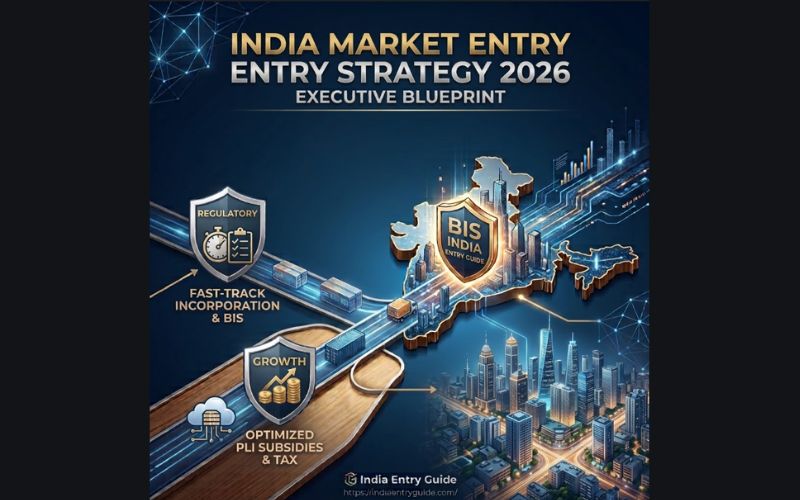
🗺️ Visual Data Summary: Mapping Your 2026 India Entry Blueprint
To help C-level executives visualize, streamline, and execute a flawless market expansion, our platform has mapped the core components of a modernized Indian market entry. Below is the structural breakdown of the critical regulatory, financial, and logistics touchpoints required to secure your local market footprint:
- Centralized MCA Onboarding: Executing streamlined corporate incorporation via the integrated digital SPICe+ portal to achieve rapid legal entity readiness.
- Proactive Tech Compliance Auditing: Pre-clearing import logistics by securing early-stage BIS, CRS, and EPR environmental clearances via localized NABL lab testing.
- Fiscal Optimization & Incentives: Structuring factory breaking or local sourcing models to fully exploit slashed manufacturing tax rates and active PLI subsidy payouts.
- State-Level Corridor Mapping: Anchoring operations strategically within specialized economic zones (SEZs) and dedicated freight networks to guarantee zero-delay logistics.
- Dual-Market Supply Engineering: Designing production scaling architectures that seamlessly handle both global export requirements and India’s surging domestic consumer base.
Strategic Verdict & Actionable Advice
- Appoint Your Authorized Indian Representative (AIR) Early: Do not treat product certifications as a secondary, post-incorporation checklist item. Engaging a certified local legal representative to manage your BIS and regulatory pipeline concurrently with corporate filing saves months of operational downtime.
- Run Localized Supply Chain Simulations: Before committing to a specific manufacturing corridor, execute a comprehensive evaluation of regional tier-1 component availability. Securing a reliable local sourcing network early prevents costly friction with India’s phased manufacturing value-addition laws.
📞 CONTACT US
- India HQ : +91 99807 56389
- Seoul Liaison : +82 10-7641-4018
- Email : liminae@adullamcorp.com
- Website : https://adlconsulting.in/
Copyright 2026. India Entry Guide. All rights reserved.