For foreign exporters and digital marketplace operators seeking to capture India’s booming consumer base, navigating the cross-border digital economy requires absolute regulatory alignment. India’s unified indirect tax system—the Goods and Services Tax (GST), introduced under the Central Goods and Services Tax Act, 2017—applies strictly to international digital trade.
Failing to correctly interpret destination-based consumption rules, missing mandatory digital tax registrations, or miscalculating localized withholding liabilities can lead to severe operational penalties, customs gridlocks at the Central Board of Indirect Taxes and Customs (CBIC) checkpoints, or the indefinite suspension of your local digital storefronts. For C-suite executives and cross-border tax counsels, maintaining an audited grasp of India’s digital GST architecture is a non-negotiable compliance requirement before executing high-volume commercial transactions.
Key Regulatory Frameworks for Cross-Border Digital Operators
| Transaction Type | Core GST Classification | Mandatory Local Registration | Primary Tax Responsibility |
|---|---|---|---|
| Digital Services B2C | OIDAR Services | Yes (Simplified OIDAR Portal) | Foreign Provider Remits Tax Directly |
| Physical Goods B2C / B2B | Cross-Border Importation | Via Local Entity or Importer of Record | Integrated GST (IGST) paid at Customs |
| Marketplace Intermediary | E-commerce Operator | Yes (Section 24 Mandatory Registration) | Tax Collection at Source (TCS) Withholding |
Core Regulatory Pitfalls and Strategic Insights
1. Managing OIDAR Compliance for Direct-to-Consumer Digital Services
Under the Indian GST framework, any foreign entity providing software-as-a-service (SaaS), cloud storage, e-books, data streams, or digital gaming to an unregistered Indian consumer is classified as an Online Information Database Access and Retrieval (OIDAR) service provider.
Unlike physical goods where tax is collected at the port of entry, the legal liability to pay GST on OIDAR B2C transactions rests entirely on the overseas supplier. Foreign firms must utilize the simplified registration scheme administered by the Principal Commissioner of Central Tax, Bengaluru West. Under this portal, your business must register, calculate the standard 18% GST on gross transactional values, and file monthly Form GSTR-5A returns. Operating without an active OIDAR registration triggers direct enforcement under Section 122 of the CGST Act, resulting in heavy fiscal penalties and potential domain blocking by the Ministry of Electronics and Information Technology (MeitY).
2. Executing Tax Collection at Source (TCS) and Marketplace Intermediary Liabilities
Overseas platform operators that facilitate third-party vendor sales within the Indian market must strictly adhere to the E-commerce Operator provisions dictated under Section 52 of the CGST Act. If your platform provides the digital marketplace infrastructure where independent merchants list goods, you are legally classified as an e-commerce operator.
This status mandates a separate registration in every single Indian state where your platform suppliers operate. Crucially, your corporate treasury must implement an automated mechanism to deduct Tax Collection at Source (TCS) at a statutory rate of 1% (0.5% CGST + 0.5% SGST) from the net value of taxable supplies made through the platform. These funds must be remitted monthly to the government via Form GSTR-8, allowing Indian tax authorities to cross-reference transactions against individual vendor accounts to eliminate domestic tax evasion.
3. Optimizing Integrated GST (IGST) Levies on Cross-Border Physical Imports
For foreign exporters shipping physical products directly into India, cross-border trade falls strictly under the category of inter-state supplies governed by the Integrated Goods and Services Tax (IGST) Act, 2017. When a shipment arrives at an Indian port, the Customs Tariff Act mandates that IGST must be levied on the assessable value of the goods, including basic customs duty (BCD) and applicable social welfare surcharges.
To prevent import friction and ensure smooth supply chain logistics, foreign exporters must clearly establish who will act as the Importer of Record (IOR). If selling on a B2B basis, corporate buyers can easily claim the paid IGST as an Input Tax Credit (ITC) via their Form GSTR-2B matching protocols. However, for direct B2C physical sales, foreign operators should route deliveries through specialized domestic third-party logistics (3PL) clearing entities or localized warehouse holding companies to manage local compliance and prevent shipments from being impounded due to missing GST documentation at the point of clearance.
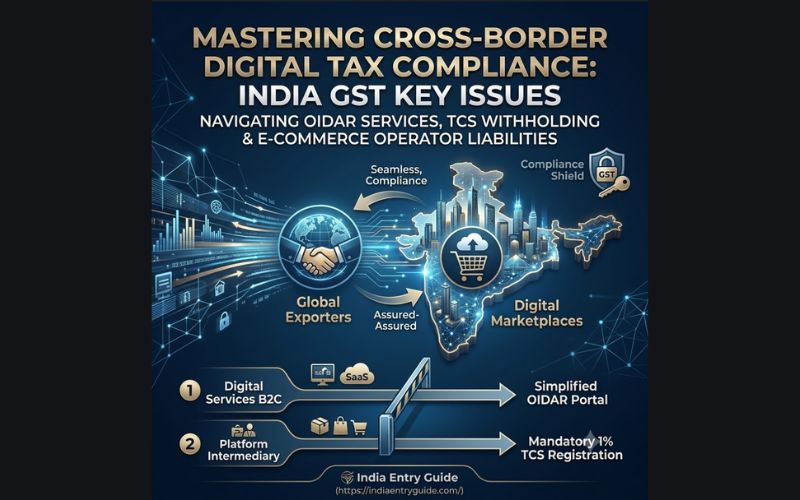
🗺️ Visual Data Summary: Navigating India’s Cross-Border GST Map
To help C-level executives streamline international tax structures, our platform has mapped the core components of cross-border GST compliance in India. Below is the structural breakdown of the localized regulatory and tax touchpoints required to protect your business from compliance enforcement:
- Digital Services Mapping (OIDAR): Automated identification of Indian end-user locations via IP verification, billing addresses, or banking origin points to trigger the standard 18% tax collection.
- Simplified Central Digital Registry: Centralized onboarding portal based in Bengaluru for foreign digital operators, bypassing the need for a physical Indian office or a local resident director.
- Cross-Border Supply Chain Management:
- B2B Shipments: Strategic alignment with local corporate buyers to ensure seamless transfer of Input Tax Credits (ITC).
- B2C E-commerce: Mandatory 1% Tax Collection at Source (TCS) implementation for platform infrastructure operators under Section 52.
- Customs Integration & IGST: Direct integration with the Central Board of Indirect Taxes and Customs (CBIC) and ICEGATE portals to verify that paid import taxes match your local logistics records.
Strategic Verdict & Actionable Advice
- Deploy Automated Geo-Location Software: Ensure your digital payment gateway is equipped to capture dual independent location indicators (such as local IP address and credit card bank origin) to accurately determine whether a consumer is within Indian tax jurisdiction.
- Establish Transparent IOR Agreements: When exporting physical goods, execute clear, legally binding terms detailing whether the foreign exporter or the local freight forwarder acts as the Importer of Record to prevent unexpected customs delays or duplicate tax exposures.
📞 CONTACT US
- India HQ : +91 99807 56389
- Seoul Liaison : +82 10-7641-4018
- Email : liminae@adullamcorp.com
- Website : https://adlconsulting.in/
Copyright 2026. India Entry Guide. All rights reserved.