For manufacturing firms looking to de-risk their global supply chains, India presents an unparalleled growth market. However, translating a corporate investment strategy into a physical production plant requires navigating a highly complex variable: industrial land acquisition. In India’s federal structure, land is an inherently localized asset governed primarily by state regulations, regional zoning codes, and competitive state-specific industrial policies.
Failing to analyze state-level variations in real estate infrastructure, regulatory single-window efficiency, and fiscal subsidies can severely delay your deployment timelines and strain initial capital reserves. For C-suite executives and general counsels, evaluating the operational and financial landscape of India’s competitive industrial states is a critical prerequisite before committing capital.
Key Regulatory Frameworks Across Top Manufacturing States
| State | Core Single-Window Portal | Key Sector Strengths | Primary Land Allotment Mechanism |
|---|---|---|---|
| Gujarat | Investor Facilitation Portal | Semiconductors, Chemicals, Automotive | GIDC Electronic Allotment & “Choose Your Incentive” Policy |
| Maharashtra | MAITRI 2.0 Portal | Electronics, Electric Vehicles, Pharma | MIDC Direct Leasehold & Fast-Track Zoning Clearance |
| Tamil Nadu | Guidance Tamil Nadu (Single Window) | Electronics Assembly, EV Auto Components | SIPCOT Industrial Parks & Direct GIS-Based Allotment |
Core Regulatory Pitfalls and Strategic Insights
1. Leveraging GIS Spatial Logistics and the India Industrial Land Bank (IILB)
Historically, the single largest hurdle for foreign manufacturing companies was identifying available, encumbrance-free land parcels with clear legal titles. The Department for Promotion of Industry and Internal Trade (DPIIT) has mitigated this structural challenge by deploying the National GIS Land Bank—the India Industrial Land Bank (IILB).
The IILB aggregates spatial data across more than 4,000 industrial parks spanning over 500,000 hectares. This platform allows foreign investors to evaluate plot-level parameters—including vacant acreage, terrain, surrounding forest boundaries, and proximity to national logistics corridors (such as the PM Gati Shakti National Master Plan)—remotely. Utilizing this digital infrastructure during initial due diligence eliminates reliance on localized real estate intermediaries and protects corporations from entering disputed agricultural land conversion bottlenecks.
2. Maximizing State-Level Industrial Incentives and Capital Subsidies
India’s states actively compete for foreign direct investment (FDI) through customized industrial promotion policies, which often overlay federal Production Linked Incentive (PLI) schemes. Under the latest industrial frameworks, such as the Gujarat Industrial Policy, states have pioneered highly flexible “Choose Your Incentive” mechanisms.
These frameworks allow mega-scale projects to tailor their fiscal relief packages based on their precise capital expenditure and employment timelines. Key operational incentives that corporate financial officers must evaluate include substantial capital subsidies (ranging from 10% to 25% of eligible fixed assets), long-term exemptions or refunds on State Goods and Services Tax (SGST), complete stamp duty waivers upon land registration, and multi-year power tariff concessions. For asset-heavy manufacturing setups, these state-level offsets can compress factory setup costs significantly, accelerating your path to operational profitability.
3. Navigating State-Level Single-Window Upgrades and the BRAP Framework
The timeline between initial site selection and the actual groundbreaking ceremony is dictated by the efficiency of local regulatory clearances. Under the central government’s Business Reform Action Plan (BRAP), state performance is continuously benchmarked across hundreds of distinct reform points covering construction permits, labor registrations, and environmental consents.
Top-performing industrial states have consolidated these multi-agency approvals into advanced digital single-window mechanisms, such as Maharashtra’s MAITRI 2.0 system. Rather than managing fragmented, manual applications across separate electricity boards, pollution control committees, and water authorities, corporations can submit unified dossiers with strictly enforced statutory timelines. Choosing a state with a proven, audited track record of high BRAP compliance ensures predictable time-to-market and minimizes exposure to localized bureaucratic friction.
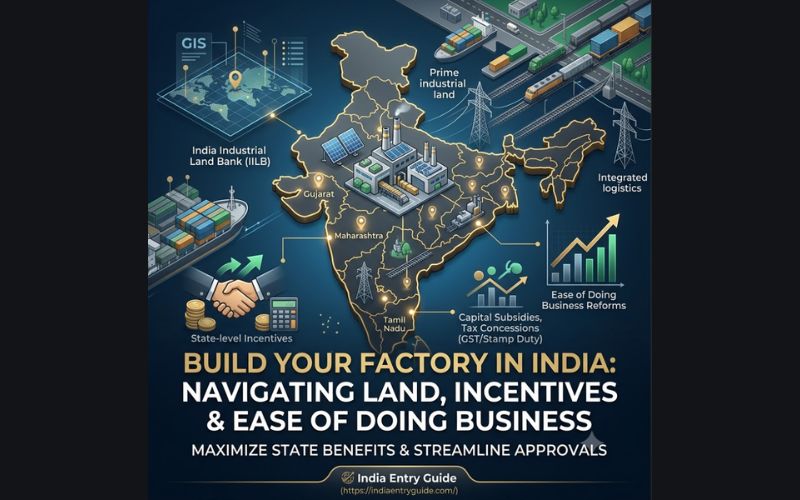
🗺️ Visual Data Summary: Navigating India’s Industrial Map
To help C-level executives streamline the site selection process, our platform has mapped the core components of a successful factory deployment in India. Below is the structural breakdown of the localized regulatory and logistical touchpoints required to maximize state benefits:
- Prime Industrial Land Identification: Focus layout targeting high-growth manufacturing clusters across major economic corridors.
- Geographic Information System (GIS) Targeting: Direct linkage to the India Industrial Land Bank (IILB) for real-time tracking of vacant acreage, infrastructure boundaries, and multi-modal connectivity.
- Targeted Manufacturing Hubs & Major Investment States:
- Gujarat: Pioneer in semiconductor ecosystems, advanced chemical zones, and automotive clusters utilizing the GIDC frameworks.
- Maharashtra: Key destination for premium electronics, electric vehicles (EV), and pharmaceuticals utilizing the fast-track MAITRI 2.0 single-window portal.
- Tamil Nadu: Leader in global electronics assembly and EV auto component supply chains backed by SIPCOT infrastructure.
- Fiscal Incentive Structuring: Direct tracking of Capital Subsidies, Tax Concessions, local State GST (SGST) refunds, and complete Stamp Duty waivers upon land registration.
- Operational Streamlining: Leveraging the national Business Reform Action Plan (BRAP) for integrated logistics and structural Ease of Doing Business reforms.
Strategic Verdict & Actionable Advice
- Execute Comprehensive Title Searches: Never commit to land outside structured government industrial zones (like GIDC, MIDC, or SIPCOT) without a rigorous 30-year historical title search to confirm the absence of litigation or agricultural tenancy encumbrances.
- Align Incentives with Infrastructure Access: Prioritize states that offer plug-and-play industrial ecosystems. A high fiscal subsidy in a remote region rarely offsets the hidden structural logistics costs of weak road-to-port connectivity or unreliable utility access.
📞 CONTACT US
- India HQ : +91 99807 56389
- Seoul Liaison : +82 10-7641-4018
- Email : liminae@adullamcorp.com
- Website : https://adlconsulting.in/
Copyright 2026. India Entry Guide. All rights reserved.