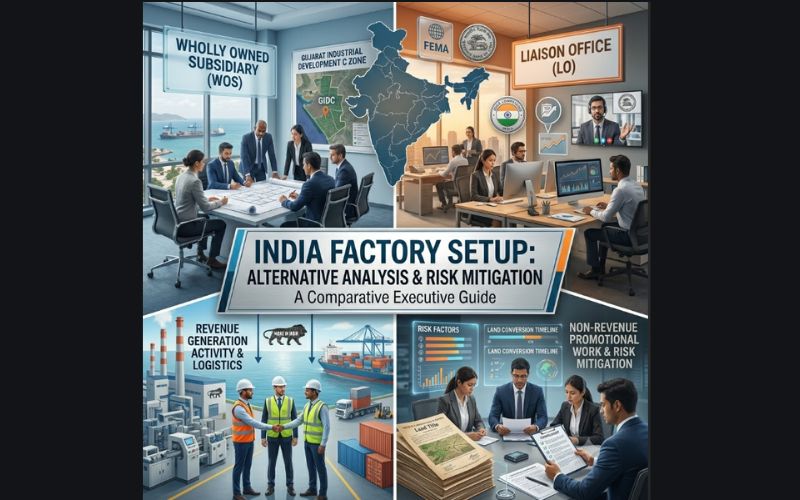
Driven by global supply chain diversification and the strategic momentum of the ‘Make In India’ initiative, India is rapidly emerging as the world’s most attractive manufacturing hub. Countless global manufacturing firms and multi-national corporations are actively evaluating the establishment of localized production facilities to secure a foothold in India’s massive domestic market and establish a resilient export base.
However, given India’s vast geographical scale, each state presents entirely different characteristics regarding local regulations, infrastructure development, languages, and labor environments. Furthermore, due to complex land title structures and bureaucratic administrative processes, many foreign enterprises face indefinite project delays during the land acquisition phase without thorough preliminary research. This comprehensive guide provides critical insights into regional industrial zone suitability and operational risk mitigation strategies for successful factory deployment in India.
1. Regional Industrial Zone Analysis: Strategic Clusters Across India
Manufacturing ecosystems in India are highly clustered around three major economic corridors: Northern, Western, and Southern India. Selecting an optimal location aligned with your specific industry vertical and target clientele is the critical first step.
- The Northern Corridor (Delhi NCR, Haryana, Uttar Pradesh): Centered around the capital region, this cluster boasts a highly matured ecosystem for automotive components and electronics manufacturing. It is highly advantageous for tier-1 and tier-2 suppliers seeking proximity to major established global manufacturers. Being a landlocked region, it is ideally suited for enterprises focusing heavily on domestic distribution rather than maritime logistics.
- The Western Corridor (Maharashtra, Gujarat): Encompassing Mumbai, the financial epicenter of India, this region offers elite port infrastructure, making it the premier choice for export-oriented manufacturing firms. Gujarat, in particular, is highly favored by global corporations due to its investor-friendly regulatory environment and highly stable power and industrial water supply.
- The Southern Corridor (Tamil Nadu, Karnataka, Andhra Pradesh): Anchored by Chennai—often referred to as the ‘Detroit of India’—this corridor features highly advanced automotive, electronics, and IT hardware industrial clusters. The region presents a distinct competitive advantage with its highly educated labor pool and robust port connectivity, facilitating seamless maritime exports to Southeast Asian and global markets.
2. Navigating Land Acquisition in India: 3 Critical Risks to Avoid
Securing a factory site in India involves significantly more legal and administrative hurdles compared to Western or East Asian markets. Global implementation teams frequently encounter the following three systemic risks:
- Unclear Land Title and Ownership Disputes: Historically, land registry records in many parts of India were managed manually or passed down through generations via un-digitalized documentation. This creates a high risk of title disputes. Foreign enterprises may face severe injunctions or halted construction if local landowners or extended family relatives mount sudden legal challenges post-purchase.
- Delays in Regulatory Approvals and Land-Use Conversion: The administrative process of converting agricultural land into certified industrial usage—known as the NA (Non-Agricultural) Conversion—is notoriously bureaucratic. Due to state-level administrative backlogs, this single approval can routinely take over a year, escalating initial capital expenditure and stalling time-to-market.
- Deficiencies in Essential Industrial Infrastructure: While a plot may appear structurally perfect on paper, physical reality often reveals narrow access roads incapable of handling heavy-duty cargo freighters, or a severe deficit in localized power grids and industrial water supply capacity. Foreign investors must be cautious not to inadvertently inherit the massive financial burden of developing primary infrastructure linkages.
3. Shifting to Government-Backed Industrial Parks (GIDC, MIDC, SIPCOT)
The most effective operational strategy to completely neutralize title fraud and land-use conversion risks is to avoid direct private land purchases altogether. Instead, global enterprises should seek long-term lease allocations within designated industrial estates managed by State Government Industrial Development Corporations.
- Premier Government Industrial Estates: Prominent examples include Gujarat’s GIDC (Gujarat Industrial Development Corporation), Maharashtra’s MIDC, and Tamil Nadu’s SIPCOT.
- Strategic Operational Advantages: Because the state government has already legally cleared the land titles and finalized all non-agricultural conversions prior to allotment, legal risk is virtually non-existent. Furthermore, critical utilities—including high-capacity power grids, industrial water lines, access highways, and effluent treatment plants—are pre-installed. This minimizes unforeseen operational variables, and the standard 99-year long-term lease structure offers operational stability equivalent to outright ownership.
4. Operational Checklist for Global Factory Deployment Managers
Project directors overseeing factory setup in India must adhere to three fundamental execution principles:
- Institutionalize Comprehensive Due Diligence: If evaluating private land options outside government zones, it is imperative to retain independent local legal counsel to conduct a rigorous Title Search Report spanning a minimum of 30 years of historical transaction ledger data.
- Comparative Analysis of State-Level Incentives: Indian states compete aggressively for foreign direct investment, offering varied subsidies, capital grants, and fiscal incentives (such as property tax exemptions or electricity duty waivers). A comprehensive cross-state fiscal comparison tailored to your specific industry code is mandatory.
- Calibrate Realistic Project Timelines: Administrative workflows in India operate on distinct localized timelines. When structuring your plant commissioning milestones, incorporate a buffer of at least 1.5 times the standard timeline used in domestic markets to account for regulatory licensing, environmental clearances, and heavy machinery customs clearance.
5. Technical Document Architecture: Balancing Visual Media and Text Volume for Manufacturing Layouts
When global manufacturing enterprises present factory deployment strategies to their investment committees or board members, the integration of visual media—such as AI-generated spatial factory layouts, infrastructural maps, and logistical flowcharts—provides an immediate, comprehensive data layer. However, within the matrix of global search engine algorithms and multi-national corporate auditing, relying strictly on visual assets introduces a structural blind spot. To secure maximum digital indexability and establish unassailable corporate authority on Indian manufacturing codes, technical platforms must systematically reinforce heavy visual graphics with extensive, context-rich textual data.
Search engine crawlers primarily execute programmatic analysis through raw HTML text data rather than raw image pixels. A webpage detailing Indian industrial zones (such as GIDC or MIDC) that only contains an assortment of card news or map images will routinely be categorized as a thin-content profile, severely hindering organic search rankings. By explicitly laying down extensive analytical prose directly beneath the visual assets, developers provide the exact semantic keywords—such as “land-use conversion protocols,” “30-year property title historical ledgers,” and “FDI manufacturing compliance”—that algorithmic bots require to grant an elite domain authority score.
Furthermore, this text volume must not merely describe the visual element but should serve as an intellectual extension of the data. For instance, while an AI infographic can elegantly outline the geographical location of Tamil Nadu’s SIPCOT or Gujarat’s manufacturing clusters, the supporting text blocks must dissect the precise statutory tax rebates, specific moisture control liabilities for electronic hardware brands, and real-time supply chain vulnerabilities at port bottlenecks. This unified architectural paradigm—where premium visual frameworks are structurally synchronized with high-volume, expert-level corporate prose—remains the absolute gold standard for passing rigorous programmatic monetization reviews and dominating international search networks.
Conclusion: Thorough Site Selection Dictates Long-Term Market Success
Establishing a manufacturing facility in India is a multi-decade commitment that defines the structural roots of your global supply chain. Rather than being enticed solely by low real estate pricing, global firms must prioritize long-term logistical efficiency, infrastructure stability, and state-level administrative cooperation.
By prioritizing verified government industrial parks and systemically neutralizing regulatory risks with expert local guidance, global corporations can successfully build a highly stable production foundation and capture a dominant competitive advantage in the expanding Indian market. Ensure your first step is executed with precision.
📞 CONTACT US
- India HQ : +91 99807 56389
- Seoul Liaison : +82 10-7641-4018
- Email : liminae@adullamcorp.com
- Website : https://adlconsulting.in/
Copyright 2026. India Entry Guide. All rights reserved.