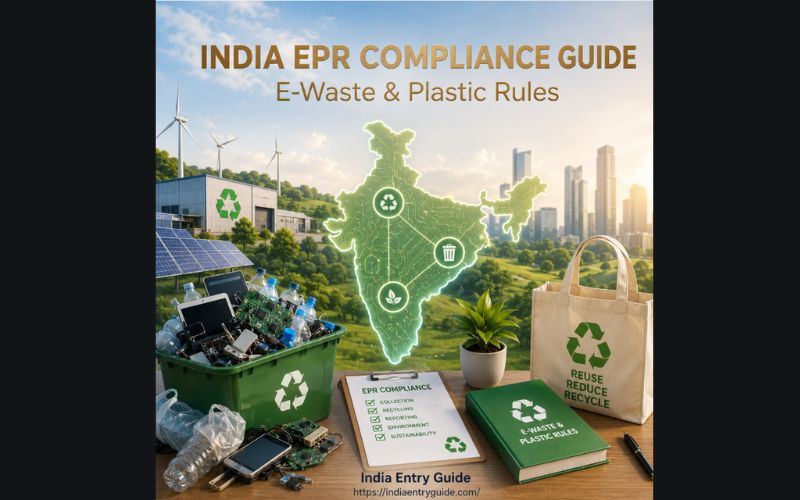
For global technology enterprises and electronic brands, navigating EPR Compliance for E-Waste India has become a core operational mandate. As the domestic consumer market expands, the Ministry of Environment, Forest and Climate Change (MoEFCC) has radically tightened its oversight. The updated Extended Producer Responsibility (EPR) frameworks now stand as strict statutory gates for any enterprise introducing electronics, IT hardware, or plastic packaging into the Indian market.
Under the Central Pollution Control Board (CPCB) guidelines, EPR Compliance for E-Waste India is a legally binding, quantified recycling obligation. Prohibited from operating without a validated registration, “Producers, Importers, and Brand Owners” (PIBOs) must actively manage the entire lifecycle of their post-consumer waste. Failing to meet these digitized recycling targets triggers severe financial liabilities under the newly implemented Environmental Compensation (EC) charges. This operational playbook breaks down how to strategically audit your EPR pipeline and secure your cross-border supply chain safety.
🗺️ Visual Data Card: The India EPR Compliance Architecture
To help compliance officers, supply chain directors, and financial planners map out their environmental documentation runway, we have structured the mandatory compliance layers defined by the CPCB below. Use this visual guide to review your entity’s local environmental reporting readiness:
- Layer 1: The Centralized PIBO Registration — Securing an official EPR registration certificate through the CPCB’s centralized online portal prior to placing any regulated product on the market.
- Layer 2: Quantified Recycling Targets — Meeting progressive, weight-based annual collection and recycling quotas calculated strictly from your historical market footprint.
- Layer 3: EPR Credit Trading Ledger — Procuring certified recycling credits exclusively from CPCB-authorized local recyclers via the official online portal to offset your annual compliance deficits.
- Layer 4: Environmental Compensation (EC) Protection — Maintaining flawless documentation to insulate your subsidiary from automated financial penalties that apply retroactively for target shortfalls.
🔍 Deep-Dive Analysis: Strategic EPR Compliance for E-Waste India
1. Plastic Waste Management (PWM) Rules: Navigating the Four Categories
Under India’s Plastic Waste Management Rules, the CPCB has structured plastic packaging into four distinct regulatory categories. Every international brand owner must precisely audit their product portfolio to map their specific packaging variables:
- Category I: Rigid plastic packaging (demanding high structural durability and material tracing).
- Category II: Flexible plastic packaging of single-layer or multilayer configurations.
- Category III: Multilayered plastic packaging containing at least one layer of plastic and other non-plastic materials.
- Category IV: Plastic sheets or structures used for packaging as well as carry bags made of compostable plastics.
Each category carries independent, escalating recycling targets and minimal recycled content mandates. If your international procurement teams fail to track and report the exact weight and category split of plastic introduced into the domestic grid, your consolidated EPR portal account faces immediate suspension.
2. E-Waste Management Rules: The Shifting Weight of IT Asset Lifecycles
To ensure full EPR Compliance for E-Waste India, global technology enterprises, medical equipment manufacturers, and consumer electronics desks must navigate an intensive compliance framework. The regulations cover a comprehensive schedule of electrical and electronic equipment (EEE), placing the absolute burden of collection on the producer based on historical average life-of-product matrices.
Unlike historical frameworks where compliance was managed via opaque third-party contracts, the modern regime operates entirely through a Digital Token System on the CPCB E-Waste Portal. Producers must achieve their annual recycling targets by purchasing EPR Credits generated online by registered, authorized recyclers who physically dismantle and process equivalent volumes of electronic waste.
3. Environmental Compensation (EC): The Financial Risk of Compliance Shortfalls
The most significant regulatory shift in India’s environmental framework is the transition from nominal administrative fines to the high-liability mechanism of Environmental Compensation (EC). Designed under the “Polluter Pays Principle,” EC charges are not a substitute for compliance—they act as an aggressive financial enforcement tool.
If an enterprise fails to acquire sufficient EPR credits to cover its annual category targets, the CPCB levies an immediate, weight-based EC penalty. Crucially, paying the Environmental Compensation fee does not absolve your subsidiary of its recycling obligations; the target deficit rolls over into the subsequent fiscal year. However, the framework provides a strategic financial recovery window: if your enterprise successfully fulfills the rolled-over target shortfall within a three-year statutory window, up to 75% to 100% of the paid EC funds are fully refunded to your corporate treasury.
📊 India Plastic & E-Waste EPR Compliance Matrix
| Waste Stream Type | Primary Regulatory Driver | Mandated Compliance Mechanism | Primary Enterprise Risk Vector |
|---|---|---|---|
| Plastic Packaging | Plastic Waste Management Rules | Categorized portfolio reporting (Cat I-IV) & recycled content quotas | Port suspensions & retroactive EC charges for incorrect classification |
| E-Waste (EEE Assets) | E-Waste Management Rules | Digital EPR Credit procurement and matching via CPCB online portal | Automated penalties for unverified credit sourcing |
| Annual Reporting | CPCB Statutory Guidelines | Filing comprehensive quarterly and annual returns via central portals | Account lockouts and freeze of downstream commercial distribution |
| Financial Safeguards | Environmental Compensation Regime | Rolling target recovery mechanism with a 3-year refund runway | Compounding target deficits leading to severe capital drain |
📱 [Quick Slide] 3-Minute Executive Card News
Rapidly review the core financial and environmental compliance pillars of India’s EPR framework. Use these structured insights to brief your executive board.
💳 Card 1: Mandatory Gatekeeping (The PIBO Registration)
- Executive Summary: Securing absolute EPR Compliance for E-Waste India requires an active CPCB EPR registration before market entry.
- Operational Check: Do not launch commercial distribution without a validated registration number. Unauthorized market entry triggers immediate supply chain blocks and severe civil liabilities.
💳 Card 2: Digital Credit Sourcing (The Portal Registry)
- Executive Summary: EPR targets must be offset exclusively through digitized credits traded on the official CPCB portal.
- Operational Check: Audit your local recycling networks aggressively. Paper-based certificates or off-platform transactions are legally invalid and will fail to clear your statutory annual quota liabilities.
💳 Card 3: Environmental Compensation (The Target Rollover)
- Executive Summary: Paying an environmental penalty does not erase your unmet recycling obligations.
- Operational Check: Unfulfilled targets roll over automatically. Utilize the 3-year target recovery window to execute delayed recycling operations and reclaim paid compensation funds back to your treasury.
💳 Card 4: Governance Ownership (The Portal Blueprint)
- Executive Summary: Navigating dynamic environmental targets requires direct enterprise control over corporate credentials.
- Operational Check: Never cede your centralized CPCB portal profiles or authorized representative configurations to third-party brokers. Maintain direct oversight to ensure absolute data consistency and regulatory safety.
Strategic Verdict & Actionable Advice for the Boardroom
- Execute Independent Material Audits at the Factory Level: Instruct your global packaging and product design teams to perform precise, weight-and-material audits prior to shipping cargo to India. Ensuring that your local subsidiary possesses verified data sheets for every single layer of plastic or component grid prevents catastrophic misclassification penalties during routine CPCB electronic portal cross-checks.
- Incorporate EPR Compliance Clauses into Supplier Contracts: Hardcode clear environmental indemnity clauses into your agreements with local manufacturing facilities, distributors, and logistics partners. Mandating that downstream entities provide real-time, audit-ready data logs on waste generation insulates your enterprise from unexpected liability exposure if a localized vendor fails a regional regulatory inspection.
📞 CONTACT US
- India HQ : +91 99807 56389
- Seoul Liaison : +82 10-7641-4018
- Email : liminae@adullamcorp.com
- Website : https://adlconsulting.in/
Copyright 2026. India Entry Guide. All rights reserved.