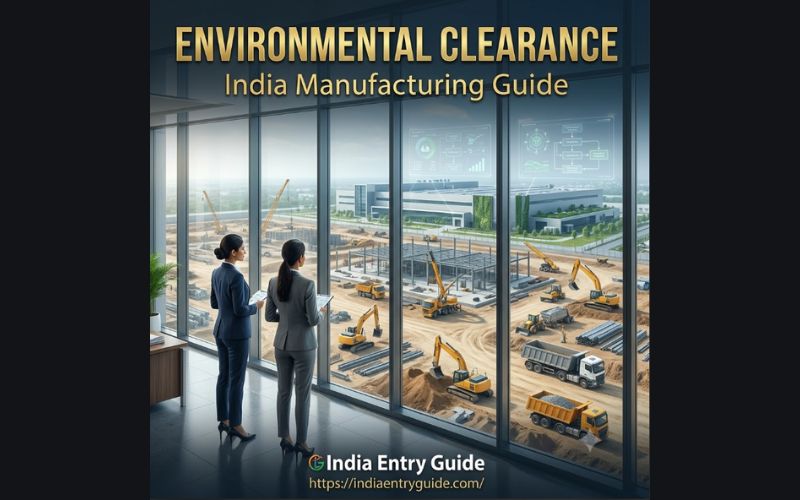
For multinational industrial groups, cross-border manufacturing giants, and foreign direct investors looking to set up manufacturing facilities in Southern Asia, statutory compliance goes far beyond standard corporate registration. To leverage the massive domestic momentum of the “Make in India” initiative, international boardroom desks must first clear a critical regulatory hurdle. Navigating the complex architecture of Environmental Clearance Regulations India stands as the definitive operational framework that determines whether your manufacturing project can legally break ground or faces devastating port and construction freezes.
Under the domestic industrial grid, environmental sustainability is tightly governed by the Ministry of Environment, Forest and Climate Change (MoEFCC) alongside Central and State Pollution Control Boards (CPCB/SPCB). Rushing into development without securing formal prior clearance is corporate suicide. The Indian environmental legal system enforces automated oversight platforms and strict technical categories that cannot be bypassed via unverified local middle brokers. To insulate your international capital from sudden regulatory shutdowns and compounding penalty exposure, your technical and legal teams must follow a flawless execution blueprint. This institutional playbook breaks down the exact statutory categories, public hearing mechanisms, and post-clearance workflows required to secure your plant’s compliance runway.
🗺️ Visual Data Card: The India Environmental Clearance (EC) Architecture
To help compliance officers, technical plant directors, and project engineering desks map out their environmental clearance strategy, we have structured the mandatory evaluation layers below. Use this visual guide to audit your project’s technical and environmental readiness:
- Layer 1: Category-Based Screening Moats — Dividing industrial projects into Category A (centralized federal approval) or Category B (state-level scrutiny) based on manufacturing capacity and pollutant intensity.
- Layer 2: Comprehensive Scoping & EIA Studies — Executing a rigorous Environmental Impact Assessment (EIA) to create baseline scientific data logs tracking localized air, water, and soil displacement.
- Layer 3: The Public Consultation Gate — Conducting mandated public hearings with local communities and environmental stakeholders to address regional grievances and secure a clean social license to operate.
- Layer 4: Continuous Half-Yearly Compliance Monitoring — Submitting automated, data-backed environmental compliance reports twice a year to maintain active, valid operational permits.
🔍 Deep-Dive Analysis: Navigating Environmental Clearance Regulations India
1. The Screening Filter: Deciphering Category A vs Category B Projects
The primary structural requirement for setting up an industrial manufacturing facility is identifying your project’s technical allocation under the Environmental Impact Assessment (EIA) Notification. When decoding Environmental Clearance Regulations India, corporate desks must recognize that projects are split into Category A and Category B based on potential environmental impacts.
Category A manufacturing units—which include large-scale chemical processors, heavy metallurgical plants, petroleum refineries, and high-capacity infrastructure developments—are evaluated directly by the central Expert Appraisal Committee (EAC) under the MoEFCC. Category B projects, which generally cover mid-sized manufacturing, are managed at the state level by the State Expert Appraisal Committee (SEAC). Misclassifying your plant’s technical specifications at the outset stalls your entire project registry, as a Category A facility attempting state-level filing will face immediate application rejection and costly administrative delays.
2. The Scoping and EIA Study: Hardcoding Data Integrity
Once your category is established, your technical consultants must draft the Terms of Reference (ToR) to outline the scope of the required Environmental Impact Assessment (EIA) study. The resulting EIA report is not a simple bureaucratic formality; it is a highly detailed, data-driven scientific document.
Your environmental partners must collect comprehensive baseline data tracking ambient air quality, industrial wastewater discharge pathways, solid waste management plans, and regional ecological impacts across multiple seasons. Indian regulatory desks utilize automated monitoring tools to verify the validity of these data streams. If an international firm submits a superficial or rushed EIA report relying on outdated regional metrics, the appraisal committee will instantly issue technical pushbacks, forcing your engineering team to restart long-term environmental testing from scratch.
3. The Public Consultation Hurdle and Post-Clearance Validation
The final operational hurdle before receiving an Environmental Clearance (EC) letter is navigating the mandatory public consultation phase. This process requires holding formal public hearings managed by the SPCB near your planned industrial site, allowing local residents to review your EIA summary and raise environmental or logistical concerns.
Successfully clearing this stage requires presenting transparent community development frameworks and rock-solid environmental protection strategies. Once the EC is formally granted, your statutory duties do not end. Foreign subsidiaries must secure additional operational permits, specifically the Consent to Establish (CTE) and Consent to Operate (CTO) from the respective SPCB. Furthermore, you are legally mandated to submit verified compliance data every six months, proving your manufacturing lines strictly adhere to the conditions laid out in your original EC letter.
📊 India Manufacturing Environmental Clearance Matrix
| Regulatory Dimension | Primary Governing Authority | Mandated Statutory Mechanism | Primary Enterprise Risk Vector |
|---|---|---|---|
| Category A Appraisals | Central EAC / MoEFCC | Centralized federal review & direct Ministerial clearance | Multi-month approval delays and nationwide project halts if misclassified |
| Category B Appraisals | State SEAC / SEIAA | State-level screening, scoping, and evaluation pipelines | Regional policy variations and fragmented bureaucratic timelines |
| Public Consultation | Respective SPCB & District Magistrate | Mandated localized public hearings & written grievance reviews | Local social friction, project blockages, and intense brand damage |
| Post-Clearance Operations | State Pollution Control Board (SPCB) | Procurement of CTE/CTO & mandatory half-yearly reporting | Immediate plant closure, frozen assets, and personal director liability |
📱 [Quick Slide] 3-Minute Executive Card News
Rapidly review the core screening, evaluation, and reporting pillars of India’s environmental clearance framework. Use these structured insights to brief your international manufacturing directors and legal teams.
💳 Card 1: Category Screening Integrity (The First Filter)
- Executive Summary: Industrial manufacturing approvals are strictly segregated by project scale and pollutant intensity.
- Operational Check: Verify whether your manufacturing capacity pushes your facility into a Category A central review or a Category B state review before purchasing industrial land plots.
💳 Card 2: Scientific EIA Data Moats (The Assessment Bedrock)
- Executive Summary: Environmental Impact Assessments require rigorous, multi-season baseline data tracking to pass federal audits.
- Operational Check: Instruct your engineering consultants to deploy real-time monitoring tools for air and water metrics. Submitting bulletproof scientific data eliminates long-term technical pushbacks.
💳 Card 3: The Public Consultation Gate (The Social License)
- Executive Summary: Securing a valid Environmental Clearance requires formal interaction with local communities to address environmental concerns.
- Operational Check: Approach public hearings with proactive corporate social responsibility (CSR) roadmaps and transparent safety frameworks to eliminate regional friction.
💳 Card 4: Immutability of Half-Yearly Audits (The Post-EC Era)
- Executive Summary: An Environmental Clearance is not a one-time paper approval; it requires continuous compliance tracking.
- Operational Check: Ensure your local plant management team uploads verified compliance reports every six months. Continuous consistency prevents sudden CTO cancellations and plant shutdowns.
Strategic Verdict & Actionable Advice for the Boardroom
- Execute an Independent Environmental Due Diligence Audit Prior to Land Acquisition: Instruct your global EHS (Environmental, Health, and Safety) and legal teams to run custom diagnostic mapping on any proposed industrial land site before signing purchase agreements. Verifying localized zoning laws, eco-sensitive zone (ESZ) borders, and state-specific SPCB rules protects your capital from buying land that cannot legally obtain an Environmental Clearance.
- Maintain Centralized Executive Oversight Over SPCB Consent Frameworks: Do not pass the entire management of your Consent to Establish (CTE) and Consent to Operate (CTO) applications completely to unverified local contractors. Keep direct, executive-level monitoring over your environmental data logs to respond instantly to regulatory audits and turn transparent compliance into an unassailable commercial defense wall.
📞 CONTACT US
- India HQ : +91 99807 56389
- Seoul Liaison : +82 10-7641-4018
- Email : liminae@adullamcorp.com
- Website : https://adlconsulting.in/
Copyright 2026. India Entry Guide. All rights reserved.