For Fortune 500 boardrooms and global supply chain architects, reliance on a single manufacturing hub is no longer a viable risk management strategy. Driven by lingering geopolitical frictions, unpredictable regulatory shifts, and rising industrial overheads, multinational corporations are actively executing the “China+1” strategy. India has emerged as the premier beneficiary of this historic macroeconomic realignment, capturing billions in foreign direct investment (FDI).
Failing to establish a diversified secondary manufacturing footprint, miscalculating cross-border logistics lanes, or ignoring localized production incentives can leave global enterprises highly vulnerable to single-source supply chain disruptions. For C-suite executives, Chief Operating Officers (COOs), and investment directors, assessing India’s modernized industrial infrastructure and manufacturing policies is a critical imperative to safeguarding global market share.
Key Macroeconomic Indicators: China vs. India Manufacturing Paradigm
| Strategic Operational Metric | Mainland China Manufacturing Hub | Modernized Indian Manufacturing Hub | Global Supply Chain Impact |
|---|---|---|---|
| Labor Demographic Curve | Aging workforce; rapidly rising median wages | Massive, young workforce; highly competitive wages | Long-term cost optimization |
| Government Policy Push | Mature infrastructure; tighter regulatory grips | Aggressive PLI subsidies & corporate tax cuts | Enhanced ROI on capital expenditure |
| Domestic Market Potential | Saturated consumer tech & automotive tiers | Hyper-growth middle class; massive domestic scale | Dual benefit: Export base + Local market |
Core Regulatory Pitfalls and Strategic Insights
1. Leveraging the PLI Subsidies and Corporate Tax Concessions
The primary operational catalyst drawing Fortune 500 companies to Indian soil is the government’s aggressive fiscal onboarding framework. To directly challenge established manufacturing hubs, India introduced slashed corporate tax rates for new domestic manufacturing setups, dropping the base rate down significantly to incentivize immediate factory breaking.
Coupled with the flagship Production Linked Incentive (PLI) schemes spanning critical sectors—such as advanced electronics, pharmaceuticals, automotive components, and renewable energy hardware—multinationals can offset a massive percentage of their initial setup costs. Chief Financial Officers must structurally align their multi-year capital expenditure (CapEx) tracking with India’s Ministry of Commerce guidelines to fully unlock these multi-million dollar cash-back milestones.
2. Navigating Localized Value-Addition and Sourcing Mandates
While India offers an incredibly lucrative entry framework, foreign manufacturers often stumble into the legal complexities of domestic value-addition requirements. Moving a simple assembly line (semi-knocked down or SKD kits) to India to bypass tariffs without investing in local supply ecosystems is a short-sighted approach that often faces strict regulatory resistance.
Under modern Indian manufacturing mandates, businesses must demonstrate a clear, annual progression in localized component sourcing—often referred to as Phased Manufacturing Programmes (PMP). This requires a strategic commitment to onboarding local tier-1 and tier-2 suppliers or convincing overseas component partners to co-locate within India’s newly established industrial corridors. Failing to meet these local sourcing curves can lead to a sudden loss of preferential customs duties and subsidy disqualification.
3. Optimizing Industrial Logistics via Special Economic Zones (SEZs) and Dedicated Corridors
Historically, bureaucratic red tape and fragmented domestic logistics presented a significant bottleneck for global enterprises entering India. To eliminate these traditional frictions, the modern Indian infrastructure blueprint relies on Dedicated Freight Corridors (DFCs) and modernized Special Economic Zones (SEZs) or National Investment and Manufacturing Zones (NIMZs).
Operating within an approved SEZ unlocks a streamlined single-window clearance ecosystem, completely bypassing multi-tiered local municipal approvals. Furthermore, these zones are physically integrated with high-speed cargo corridors linking manufacturing hubs directly to major automated ports, such as JNPT in Mumbai or Mundra in Gujarat. Supply chain directors must strategically anchor their manufacturing facilities within these dedicated zones to guarantee predictable, zero-delay export timelines to Western and Asian markets.
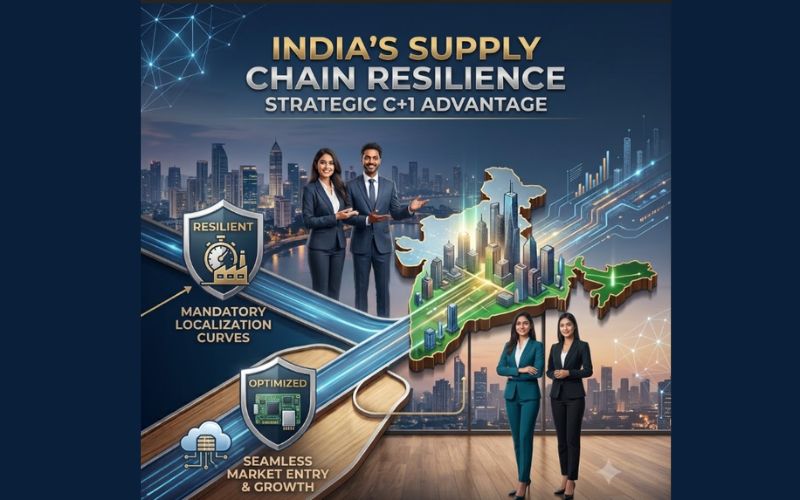
🗺️ Visual Data Summary: Navigating India’s China+1 Supply Chain Map
To help C-level executives streamline international manufacturing relocations and secure a resilient secondary production base, our platform has mapped the core components of a successful China+1 hardware deployment in India. Below is the structural breakdown of the localized regulatory, logistics, and tax touchpoints required to optimize your operational migration:
- Strategic Fiscal Onboarding: Utilizing hyper-competitive manufacturing corporate tax structures and maximizing multi-sector PLI cash-back streams.
- Supply Chain Localization: Structuring a Phased Manufacturing Programme (PMP) to systematically transition from SKD assembly to deep component localization.
- Infrastructure Optimization: Practical facility positioning within Dedicated Freight Corridors (DFCs) and SEZs to ensure seamless multi-modal export access.
- Bureaucratic Single-Window Access: Bypassing regional administrative friction by leveraging centralized, digital regulatory clearance portals.
- Global Market Dual-Tracking: Engineering production capacities to seamlessly serve both high-velocity international export demands and India’s booming domestic consumer market.
Strategic Verdict & Actionable Advice
- Onboard Local Compliance Experts Early: Do not attempt to replicate a standard East-Asian logistics playbook in India. Localized compliance consulting is vital to correctly interpreting inter-state GST structures and customs classification updates.
- Map Out Your Tier-2 Supply Chain Strategy: Before ground-breaking on a final assembly plant, execute a comprehensive audit of regional component ecosystems. Forcing component localization too quickly without certified local vendors can create temporary production chokepoints.
📞 CONTACT US
- India HQ : +91 99807 56389
- Seoul Liaison : +82 10-7641-4018
- Email : liminae@adullamcorp.com
- Website : https://adlconsulting.in/
Copyright 2026. India Entry Guide. All rights reserved.