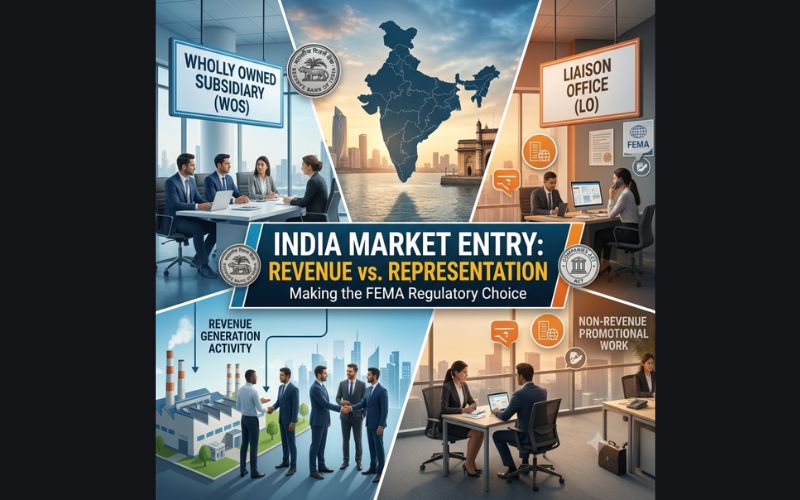
For multinational corporations with eyes fixed on India’s historic economic expansion, market entry is fundamentally a question of regulatory design. Selecting an inappropriate corporate vehicle can permanently compromise your operational agility, inflate tax liabilities, or trigger strict enforcement actions by Indian regulatory bodies. When establishing a commercial footprint, C-suite executives face a pivotal strategic crossroads: should they deploy a Wholly Owned Subsidiary (WOS) or set up a restrictive Liaison Office (LO)?
This decision demands more than a routine legal review; it requires a sophisticated assessment of your planned commercial activities, tolerance for compliance, and long-term capital allocation strategies under the Foreign Exchange Management Act (FEMA).
Key Structural Differences
| Strategic Dimension | Wholly Owned Subsidiary (WOS) | Liaison Office (LO) |
| Legal Status | Distinct Indian legal entity | Extension of foreign parent company |
| Commercial Capability | Full revenue generation & manufacturing | Purely promotional, non-revenue activities |
| Corporate Tax Exposure | Standard 22% (plus surcharge/cess) | Subject to foreign company rates (~40%) if PE triggered |
| Parent Liability | Limited to equity contribution | Unlimited (extends directly to parent) |
Core Regulatory Pitfalls and Strategic Insights
1. Permanent Establishment (PE) Hazards and Asymmetrical Corporate Taxation
A Wholly Owned Subsidiary is treated as a domestic Indian company under the Companies Act, 2013. This status unlocks highly competitive corporate tax rates, including the standard 22% rate under Section 115BAA of the Income Tax Act, 1961 (plus applicable surcharge and cess, yielding an effective rate of 25.17%).
Conversely, a Liaison Office is legally an extension of its overseas parent. While an LO is theoretically tax-exempt because it cannot generate revenue, it faces significant exposure under transfer pricing and Permanent Establishment rules. If the Indian Income Tax Department determines that an LO has stepped beyond its promotional remit—by assisting in contract negotiations, executing local agreements, or securing sales orders—the office will be classified as a dependent agent PE. This subjects the parent company’s attributed global revenues to India’s steep 40% foreign corporate tax rate, plus severe penalties.
2. Commercial Viability and RBI Enforcement Under FEMA Guidelines
The structural boundaries set by the Reserve Bank of India (RBI) create a stark divide between these two corporate vehicles. A WOS offers complete operational freedom; it can execute local contracts, issue commercial invoices, acquire real estate, and pursue manufacturing or trading under the automated Foreign Direct Investment (FDI) route across most sectors.
An LO operates under highly restrictive rules. It is barred from conducting any commercial, industrial, or trading business, even indirectly. Its permitted activities are strictly limited to market research, acting as a communication channel for the parent entity, and facilitating import-export links. Crucially, an LO cannot fund its operations through local revenue; all local expenses must be met entirely via inward hard-currency remittances from the overseas head office. Any deviation from this funding structure triggers direct enforcement audits by the Directorate of Enforcement (ED) for FEMA non-compliance.
3. Setup Timelines and Cross-Border Governance Requirements
Establishing an LO requires a complex, multi-layered approval pipeline via an Authorized Dealer (AD) Category-I Bank, which cross-references the application against RBI benchmarks. The parent company must demonstrate a net worth of at least USD 50,000 and a profitable track record over the preceding three financial years in its home jurisdiction.
A WOS features an integrated digital onboarding route via the Ministry of Corporate Affairs (MCA) SPICe+ portal, combining company incorporation with PAN, TAN, and GST registrations. A WOS does not have an external minimum net worth requirement, though it must appoint at least two directors, one of whom must be an Indian resident (living in India for 182 days or more during the calendar year). While a WOS demands a higher level of continuous governance—including mandatory statutory audits, Board meetings, and annual MCA filings—it establishes a permanent corporate presence. An LO, by contrast, is typically granted an initial operating window of only three years, requiring periodic renewals and the regular submission of an Annual Activity Certificate (AAC) certified by a Chartered Accountant.
Strategic Verdict & Actionable Advice
Selecting the right entry vehicle is a critical foundational step for long-term operational success in India. If your strategic objective involves full-scale commercial operations, local invoicing, and manufacturing, the Wholly Owned Subsidiary (WOS) is the only viable path. However, if your corporate immediate goal is limited to market research, brand building, and exploratory networking without localized revenue, a Liaison Office (LO) serves as a cost-effective, low-risk alternative. Global firms must meticulously align their entity selection with their broader Asian supply chain and statutory capabilities under FEMA regulations.
- When to Choose a Liaison Office: Use an LO only if your immediate corporate objective is limited to exploratory market research, early-stage brand building, or supervising local supply chain vendors without any immediate intention to transact locally.
- When to Choose a Wholly Owned Subsidiary: If your strategy involves localized hiring, direct commercial billing, manufacturing under government incentives like the Production Linked Incentive (PLI) schemes, or long-term market expansion, a Wholly Owned Subsidiary is the only viable path forward.
1. Structural and Operational Dichotomy Under FEMA Guidelines
The regulatory boundaries established by the Reserve Bank of India (RBI) create a stark operational divide between these two corporate vehicles. A Wholly Owned Subsidiary (WOS) offers complete commercial freedom, allowing foreign parent companies to execute local contracts, issue commercial invoices, acquire industrial real estate, and engage in manufacturing or trading under the automated Foreign Direct Investment (FDI) route across most sectors.
Conversely, a Liaison Office (LO) operates under highly restrictive rules governed strictly by the Foreign Exchange Management Act (FEMA). An LO is legally barred from conducting any commercial, industrial, or trading business, even indirectly. Its permitted activities are strictly limited to market research, acting as a communication channel for the parent entity, and facilitating import-export links. Crucially, an LO cannot fund its operations through local revenue; all local expenses must be met entirely via inward hard-currency remittances from the overseas head office. Any deviation from this funding structure triggers direct enforcement audits by the Directorate of Enforcement (ED) for FEMA non-compliance.
2. Permanent Establishment (PE) Hazards and Asymmetrical Corporate Taxation
A Wholly Owned Subsidiary is treated as a domestic Indian company under the Companies Act, 2013. This status unlocks highly competitive corporate tax rates, including the standard 22% rate under Section 115BAA of the Income Tax Act, 1961 (plus applicable surcharge and cess, yielding an effective tax rate of 25.17%). This transparent structure provides immense financial predictability for multinational corporate treasuries.
Conversely, a Liaison Office is legally an extension of its overseas parent. While an LO is theoretically tax-exempt because it cannot generate revenue, it faces significant exposure under transfer pricing and Permanent Establishment rules. If the Indian Income Tax Department determines that an LO has stepped beyond its promotional remit—by assisting in contract negotiations, executing local agreements, or securing sales orders—the office will be classified as a dependent agent PE. This subjects the parent company’s attributed global revenues to India’s steep 40% foreign corporate tax rate, plus severe administrative penalties and retroactive interest.
3. Setup Timelines and Cross-Border Governance Requirements
Establishing an LO requires a complex, multi-layered approval pipeline via an Authorized Dealer (AD) Category-I Bank, which cross-references the application against strict RBI benchmarks. The foreign parent company must demonstrate a net worth of at least USD 50,000 and a profitable track record over the preceding three financial years in its home jurisdiction.
A WOS features a streamlined digital onboarding route via the Ministry of Corporate Affairs (MCA) SPICe+ portal, combining company incorporation with PAN, TAN, and GST registrations. A WOS does not have an external minimum net worth requirement, though it must appoint at least two directors, one of whom must be an Indian resident (living in India for 182 days or more during the calendar year). While a WOS demands a higher level of continuous governance—including mandatory statutory audits, Board meetings, and annual MCA filings—it establishes a permanent corporate presence. An LO, by contrast, is typically granted an initial operating window of only three years, requiring periodic renewals and the regular submission of an Annual Activity Certificate (AAC) certified by a Chartered Accountant.
📞 CONTACT US
- India HQ : +91 99807 56389
- Seoul Liaison : +82 10-7641-4018
- Email : liminae@adullamcorp.com
- Website : https://adlconsulting.in/
Copyright 2026. India Entry Guide. All rights reserved.