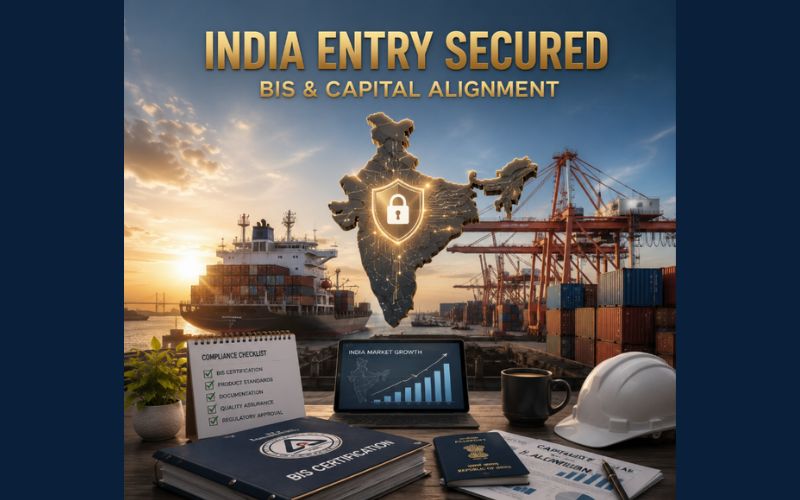
For global executive boards, international corporate counsels, and strategic growth leaders, tracking the economic velocity of Southern Asia has become a baseline operational requirement. With a staggering GDP trajectory consistently outperforming every other major economy and an expanding domestic market of over 1.4 billion consumers, the subcontinent is no longer an optional expansion destination. However, behind these spectacular headlines lies a sobering operational truth: navigating BIS Certification and Capitalization India rules stands as the definitive compliance gate that determines whether an international subsidiary thrives or suffers a catastrophic market exit.
Many foreign supply chain directors and multinational CFOs rush into the market blind, only to face a brutal wake-up call at the port of entry. When local customs authorities freeze inventory or corporate bank accounts face sudden regulatory audits, unstructured rumors often blame local operational gridlocks. In reality, under the hood of 99% of these legal disputes, the failure lies entirely with the foreign exporter trying to bypass statutory protocols. For disciplined corporate hunters who weaponize strict compliance as their legal shield, India represents an untouched, highly lucrative market. This institutional playbook deconstructs the two most imposing walls your enterprise will face—the mandatory product certification regime and the foreign exchange under-capitalization trap—and provides actionable hacks to secure your cross-border supply chain safety.
🗺️ Visual Data Card: The Dual Pillar India Entry Architecture
To help compliance officers, international logistics heads, and corporate treasury desks map out their entry strategy, we have structured the mandatory regulatory layers below. Use this visual guide to review your local entity’s technical and financial readiness:
- Layer 1: The Pre-Shipment BIS Milestone — Mapping technical product specifications against exact Indian standard metrics and securing formal quality control orders six months prior to shipping cargo.
- Layer 2: The Authorized Indian Representative (AIR) — Appointing a legally bound, permanently resident local representative to manage technical compliance and joint statutory liabilities directly with the government.
- Layer 3: The 12-Month Autonomous Capital Bedrock — Structuring your initial corporate treasury with enough capital to fully absorb twelve months of localized operational expenses without relying on local revenue.
- Layer 4: Real-Time Digital Ledger Matching — Synchronizing accounting streams with the automated, high-velocity supercomputing grid of the Goods and Services Tax Network (GSTN) to completely insulate your treasury from tax audits.
🔍 Deep-Dive Analysis: Weaponizing BIS Certification and Capitalization India Rules
1. The Quality Control Wall: Surviving the Expanded BIS Mandate
In an aggressive push to supercharge localized manufacturing through “Make in India” initiatives, the Central Government has drastically scaled its Quality Control Orders (QCOs). What historically started as strict oversight confined to heavy sectors like steel, chemicals, and automotive parts has now aggressively expanded into consumer electronics, medical tech, smart home devices, renewable energy infrastructure, and toys.
A fatal operational mistake for global supply chain desks is deploying physical inventory onto container ships before acquiring formal statutory clearances, relying on unverified local brokers to fix discrepancies post-shipment. In modern India, this approach is corporate suicide. To pass the mandatory certification regime seamlessly, your legal teams must implement a rigid pre-certification protocol. Every technical parameter must be cross-analyzed at least six months prior to cargo departure. Furthermore, foreign entities cannot apply to the Bureau of Indian Standards directly; you are legally mandated to appoint an Authorized Indian Representative (AIR) residing permanently in the country. This AIR holds immense legal authority and shares joint liability with the government for your product’s compliance, meaning you must anchor this role with an elite corporate advisory firm rather than a cheap freight forwarder.
2. The Under-Capitalization Trap: Navigating FEMA and the RBI
The biggest financial mistake global CFOs commit when expanding into India is deploying flawed conventional treasury logic: establishing the local subsidiary with a bare minimum nominal capital, intending to transfer operational cash from the parent bank account on an as-needed basis to cover payroll or office leases.
This specific treasury approach is the equivalent of hugging a live time bomb. India operates under stringent capital control laws tightly governed by the Foreign Exchange Management Act (FEMA) and monitored directly by the Reserve Bank of India (RBI). If your subsidiary launches with microscopic capital and runs out of funds within 60 days, any direct wire transferred under the guise of “operational support” will flash red on automated federal monitoring systems. Because that capital did not enter through formal Foreign Direct Investment (FDI) channels, the Income Tax Department will instantly reclassify the wire as unreported commercial revenue, slapping the entire fund amount with a 40% corporate tax bracket backed by compounding penalty interest. In extreme scenarios, federal authorities will completely freeze your local bank accounts, paralyzing your entire commercial footprint.
3. The 12-Month Autonomous Capital Hack
To neutralize this foreign exchange trap, cross-border corporate Treasuries must execute the 12-month autonomous capital hack. Your financial planning desk must calculate an airtight operational budget that can fully sustain your subsidiary for a minimum of 12 full months with zero local revenue, including calculations for office leases, salaries, accounting retainers, and marketing spend.
This entire consolidated sum must be injected on day one as formal share capital, while simultaneously filing the mandatory FCGPR form with the RBI. Capital injected through this legitimate FDI pathway is entirely untouchable by tax audits, fully recognized as a deductible expense, and insulates your corporate treasury from punitive classification errors.
📊 India Entry Compliance & Financial Safeguard Matrix
| Operational Dimension | Primary Regulatory Driver | Standard Compliant Framework | Primary Enterprise Risk Vector |
|---|---|---|---|
| Product Market Entry | BIS Quality Control Orders | Complete pre-shipment testing & formal certification 6 months prior | Immediate customs port freezes, compounding demurrage, & asset loss |
| Local Legal Governance | BIS Statutory Decrees | Appointing an elite corporate advisory firm as your local AIR | Application rejections and severe exposure due to broker errors |
| Treasury Inflows | Foreign Exchange Management Act (FEMA) | Injecting 12 months of operational runway via official FDI channels | Automated 40% revenue reclassification taxes and frozen accounts |
| Monthly Fiscal Operations | GSTN Supercomputing Grid | Real-time digital ledger matching & immediate zero-revenue filing | Immediate digital portal lockout and suspension of distribution |
📱 [Quick Slide] 3-Minute Executive Card News
Rapidly review the core operational and legal pillars of navigating BIS certification and capitalization rules. Use these structured insights to brief your international executive board and treasury desks.
💳 Card 1: The Pre-Shipment Mandate (The 6-Month Rule)
- Executive Summary: Product compliance must be established before your goods ever touch a container ship.
- Operational Check: Map your technical specifications against exact Indian standard metrics six months prior to shipping. Presenting flawless, unassailable documentation eliminates costly port clearance delays.
💳 Card 2: Strategic Governance Anchoring (The AIR Protocol)
- Executive Summary: Foreign corporate entities are legally prohibited from applying directly to the BIS portal.
- Operational Check: Appoint a permanently resident Authorized Indian Representative (AIR). Bypass cheap logistics brokers and secure an elite corporate advisory firm to handle complex technical pushbacks with legal precedence.
💳 Card 3: Neutralizing the FEMA Time Bomb (The Capital Runway)
- Executive Summary: Relying on ad-hoc intercompany bank wires to cover local office payroll triggers severe tax exposure.
- Operational Check: Inject a full 12-month autonomous operational budget on day one as formal share capital. File the mandatory FCGPR form with the RBI to ensure your funds remain completely untouchable.
💳 Card 4: Digital Tax Immutability (The Supercomputing Reality)
- Executive Summary: Modern India operates one of the most sophisticated, automated digital tax networks in existence.
- Operational Check: Ensure your local accounting partners match vendor invoices in real time via the GSTN grid. Complete digital consistency strips state authorities of any legal pretext to initiate an audit.
Strategic Verdict & Actionable Advice for the Boardroom
- Execute a Multi-Department Compliance Diagnostic Prior to Capital Deployment: Instruct your global supply chain, legal, and treasury teams to run a combined audit before initializing your corporate registry. Ensuring that your product specifications align with updated Quality Control Orders and that your initial capitalization model utilizes formal RBI direct channels prevents sudden, compounding capital drain during your early-stage commercial rollout.
- Maintain Absolute Corporate Sovereignty Over Your Digital Tax Portals: Do not cede your centralized GSTN or corporate ICEGATE access credentials entirely to third-party regional logistics brokers. Maintain executive-level oversight and deploy trusted, audited local accounting partners to ensure every single data stream is uploaded flawlessly on exact statutory dates, turning compliance into an impenetrable defense wall.
📞 CONTACT US
- India HQ : +91 99807 56389
- Seoul Liaison : +82 10-7641-4018
- Email : liminae@adullamcorp.com
- Website : https://adlconsulting.in/
Copyright 2026. India Entry Guide. All rights reserved.