For global manufacturing conglomerates, cross-border logistics firms, and foreign corporate establishment teams, shifting or expanding production into India requires a foundational structural decision. To maximize supply chain efficiency, enterprise planners must choose between two distinct legal and geographic jurisdictions: a highly incentivized Special Economic Zone (SEZ) or the standard Domestic Tariff Area (DTA).
This jurisdictional choice is not merely a matter of real estate selection—it dictates your entire corporate taxation architecture, custom clearance lag, export compliance metrics, and long-term regulatory framework. For enterprise boards structuring asset deployments in 2026, understanding the precise cost-benefit trade-offs between SEZs and DTAs is critical to turning statutory compliance into an aggressive market-entry moat. This executive playbook provides a data-driven financial and operational analysis to guide your location blueprint.
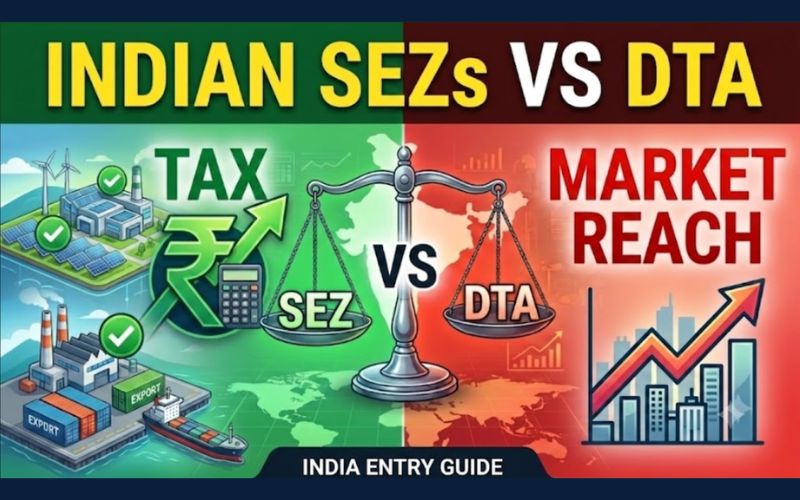
🗺️ Visual Data Card: The SEZ vs. DTA Jurisdictional Matrix
To help technology directors, legal desks, and supply chain officers audit potential site locations, we have mapped out the core operational boundaries separating these two zones. Use this visual guide to review your operational integration readiness:
- The SEZ Domain (Export-Centric Enclave) — Deemed as foreign territory for customs purposes; designed exclusively to drive net foreign exchange earnings through frictionless duty-free importing and streamlined regulatory setups.
- The DTA Domain (Domestic Market Core) — Standard domestic land territory under full Indian cross-border customs sovereignty; optimized for enterprises whose primary objective is selling directly to India’s vast internal consumer base.
- The Tariff Firewall (The DTA Sale Trap) — A mandatory customs barrier ensuring that any physical goods or digital services transferred from an SEZ into a DTA are treated as an international import, triggering full standard customs duties.
- The Compliance Pipeline (The SEZ Online Portal) — A centralized administrative interface (SEZ Online) that removes local municipal bureaucracy, allowing foreign entities to manage clear tax exemptions and clearances digitally.
Deep-Dive Analysis: Weighing Fiscal Incentives Against Market Access
1. Tax Architecture and Customs Friction: The SEZ Premium
The primary fiscal mechanism drawing multinational investment into an Indian SEZ is its complete isolation from standard customs and indirect tax friction. An SEZ unit operates as a specialized duty-free enclave. This means your enterprise can import raw manufacturing materials, heavy capital machinery, and specialized components directly from global suppliers without paying a single rupee of Basic Customs Duty (BCD) or Integrated Goods and Services Tax (IGST).
Furthermore, procurement of goods from domestic DTA suppliers into an SEZ is legally treated as a “zero-rated” export transaction. This structure effectively insulates your manufacturing hub from upfront cash flow constraints, dramatically reducing capital lock-up cycles. If your operational blueprint is 100% focused on re-exporting finished units back to North American, European, or East Asian markets, the SEZ model eliminates standard tariff drag, maximizing gross operating margins from day one.
2. The Domestic Sales Bottleneck: The DTA Advantage
While SEZs offer unparalleled fiscal insulation for export pipelines, they become highly restrictive if your primary business objective is tapping into India’s internal market. Under the SEZ Act, selling any product or service from an SEZ unit into the Domestic Tariff Area (DTA) triggers a severe regulatory mechanism: the transaction is classified as an international import.
When an SEZ unit ships finished goods across the SEZ boundary into a DTA, the local buyer (or your own domestic distribution entity) must pay full Basic Customs Duty and applicable countervailing taxes, just as if the product were being shipped from an offshore factory in Taiwan or Europe. Consequently, any manufacturing cost efficiencies achieved inside the zone are instantly erased by the tariff firewall. For foreign enterprises targeting the local Indian consumer base, setting up directly within a DTA—despite the upfront duty payments on imported machinery—is the structurally superior path to ensuring competitive local pricing.
3. Administrative Speed-to-Market: Single-Window vs. Local Bureaucracy
Beyond the financial line items, global corporate planners must closely evaluate administrative time-to-market. Historically, setting up an industrial facility within a standard DTA required navigating a fragmented maze of state-level environmental clearances, municipal building approvals, local power grid allocations, and distinct labor registrations.
SEZs mitigate this systemic friction through a mandated Single-Window Clearance system led by a dedicated Development Commissioner. Virtually all statutory permissions—ranging from initial company incorporation to daily customs clearings—are processed via a single centralized authority. This administrative consolidation bypasses local municipal gridlocks, shaving months off the physical factory deployment phase and providing a predictable, audit-ready compliance roadmap for foreign corporate compliance officers.
📊 SEZ vs. DTA Operational Benefit & Trade-off Matrix
| Operational Vector | Special Economic Zone (SEZ) | Domestic Tariff Area (DTA) | Strategic Corporate Impact |
|---|---|---|---|
| Import Duties (Machinery/Raw Materials) | 0% (Duty-Free Enclave) | Full Standard Customs & IGST | SEZ minimizes upfront capital lock-up for asset-heavy setups |
| Domestic Market Sales (Within India) | Treated as international import; full duties apply | 100% Free Access to local markets | DTA is mandatory for local consumer-facing market penetration |
| Regulatory Clearances | Centralized Single-Window via Development Commissioner | Fragmented State & Municipal Board Clearances | SEZ dramatically accelerates operational time-to-market |
| Foreign Exchange Mandate | Must maintain Positive Net Foreign Exchange (NFE) over 5 years | No foreign exchange balancing or export quotas required | SEZ requires strict export compliance audit maintenance |
📱 [Quick Slide] 3-Minute Executive Card News
Rapidly review the core financial and geographic trade-offs of India’s dual-jurisdiction framework. Use these structured cards to brief your executive board.
💳 Card 1: Strategic Alignment (The Core Objective)
- Executive Summary: Choosing between an SEZ and a DTA is determined strictly by your target consumer’s geographic location.
- Operational Check: If your primary corporate focus is global re-exporting, select an SEZ. If your target is India’s internal consumer base, deploy inside a DTA to avoid crippling tariff walls.
💳 Card 2: Cash Flow Optimization (The Duty Equation)
- Executive Summary: SEZs eliminate upfront duty drag on imported machinery and materials, boosting early-stage liquidity.
- Operational Check: DTAs require immediate payment of all import tariffs, which can strain local subsidiary funding lines during heavy industrial setup phases.
💳 Card 3: The Export Mandate (The NFE Constraint)
- Executive Summary: SEZ fiscal benefits are strictly tied to a mandatory performance metric: Positive Net Foreign Exchange (NFE).
- Operational Check: Your SEZ unit must prove it exports more cumulative value than it imports over a rolling 5-year block, requiring rigorous tracking from your accounting team.
💳 Card 4: Administrative Speed (The Clearance Runway)
- Executive Summary: SEZs bypass regional bureaucratic delays through a single-window administrative clearing hub.
- Operational Check: DTA setups require independent navigation of distinct state-level environmental and labor registries, demanding a longer pre-operational buffer in your launch timeline.
Strategic Verdict & Actionable Advice for the Boardroom
- Execute a Dual-Entity Structure for Mixed Market Models: If your corporate strategy requires both exporting globally and capturing local Indian market share, do not attempt to force a single facility to execute both. Establish an SEZ unit exclusively to service your global supply chains duty-free, and set up a separate, distinct DTA subsidiary to handle domestic localization and wholesale distribution.
- Audit the SEZ Online Access Portals Early: Instruct your local technology and logistics teams to natively integrate your enterprise ERP into the Indian SEZ Online tracking framework before launching production. Securing clean, automated data handshakes with digital customs logs prevents manual inventory tracking bottlenecks and guarantees flawless, audit-ready compliance reporting.
📞 CONTACT US
- India HQ : +91 99807 56389
- Seoul Liaison : +82 10-7641-4018
- Email : liminae@adullamcorp.com
- Website : https://adlconsulting.in/
Copyright 2026. India Entry Guide. All rights reserved.