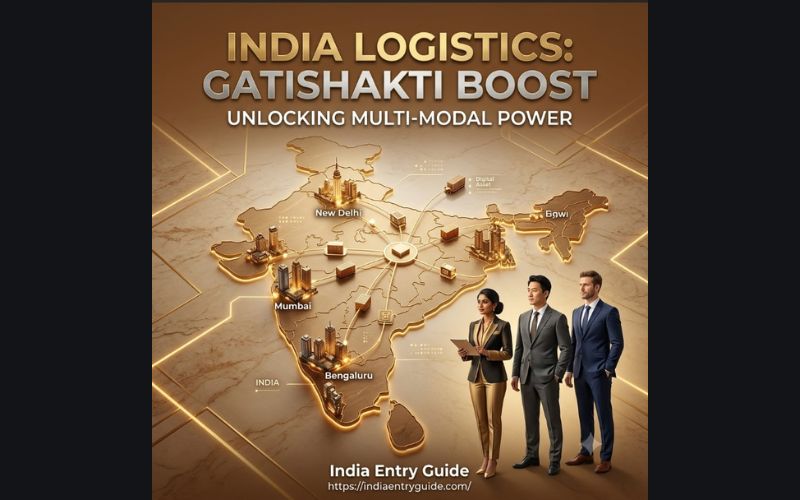
For global manufacturing conglomerates and supply chain directors looking to derisk their production networks, India’s industrial landscape is undergoing a monumental shift. Historically, the primary friction vector for foreign enterprises setting up factories in India wasn’t the lack of domestic consumer demand, but rather fragmented, multi-layered logistics bottlenecks that inflated operational costs. To aggressively dismantle these inefficiencies, the Government of India launched PM GatiShakti — the National Master Plan for Multi-Modal Connectivity.
PM GatiShakti is not merely a funding package for roads; it is a unified, GIS-powered digital infrastructure engine that synchronizes 16 government ministries (including Railways, Shipping, and Aviation). For international enterprises establishing a local presence or mapping out high-velocity supply chain networks, aligning production hubs with this master plan is critical to turning infrastructure velocity into a distinct competitive advantage.
🗺️ Visual Data Card: The GatiShakti Multi-Modal Blueprint
To help expansion teams visualize how this modernized national infrastructure layout directly connects with manufacturing hubs, we have structured the mandatory core operational nodes below. Use this visual summary to audit your next factory location alongside local logistics leads:
- Node 1: GIS-Driven Spatial Planning — Utilizing a unified geospatial platform with over 200+ database layers to seamlessly map industrial corridors and bypass localized land-use friction.
- Node 2: The Unified Logistics Interface Platform (ULIP) — Integrating disparate multi-agency tracking data into a single API ecosystem to enable real-time, end-to-end cargo visibility.
- Node 3: Dedicated Freight Corridor (DFC) Overlays — Synchronizing heavy rail networks with industrial manufacturing clusters to drastically slash transit times between inland factories and automated deep-sea container ports.
- Node 4: Automated Multi-Modal Logistics Parks (MMLPs) — Establishing strategically positioned, state-of-the-art hubs to execute frictionless freight transfers across rail, road, and maritime pathways.
Deep-Dive Analysis: The Strategic Impact on Factory Logistics
1. Eradicating Legacy Inter-Ministerial Silos via Digital GIS Integration
The defining breakthrough of PM GatiShakti lies in its centralized National Master Plan digital platform. In legacy expansion playbooks, a global company would frequently clear land for an electronics or automotive factory, only to discover that the surrounding national highway expansion, power grid laying, and dedicated railway freight line connection were completely desynchronized due to separate ministerial timelines.
The GatiShakti portal eradicates this operational downtime by mandating that all multi-sector infrastructure projects be designed, cleared, and monitored on a single geospatial screen. For foreign investors, this means the exact coordinates of proposed Special Economic Zones (SEZs), specialized warehousing clusters, and inland container depots are visible well before factory breaking runs begin, dramatically reducing time-to-market and localized bureaucratic risk.
2. Revolutionizing Cargo Velocity via the Unified Logistics Interface Platform (ULIP)
Moving freight seamlessly across domestic state borders inside India has historically been a paper-heavy and fragmented process. PM GatiShakti introduces an open API, tech-driven solution known as ULIP (Unified Logistics Interface Platform). This sub-ecosystem integrates the tracking mechanisms of shipping lines, the Ministry of Road Transport, port authorities, and customs clearance layers into a single digital dashboard.
Manufacturing plants can directly integrate their internal Enterprise Resource Planning (ERP) frameworks with ULIP APIs. This technical synchronization grants logistics directors unprecedented, granular transparency. Instead of navigating separate platforms for container customs data, highway toll movements, and rail freight status, factories gain an automated, single-pane-of-glass overview to accurately forecast supply chain arrival times and optimize inventory storage buffers.
3. Leveraging Dedicated Freight Corridors (DFCs) for Just-in-Time Operations
For advanced manufacturing sectors like semiconductors, consumer electronics, and high-tech components, reliance on erratic road transport exposes high-value freight to unnecessary transit risks and delays. PM GatiShakti places immense operational priority on maximizing the utility of India’s western and eastern Dedicated Freight Corridors (DFCs).
These heavy-haul rail lines bypass congested passenger networks entirely, enabling freight trains to travel at predictable, high-velocity speeds. By anchoring manufacturing facilities near these critical corridors, global corporations can shift their long-haul logistics from costly road transport to highly optimized, scheduled rail freight. This shift directly feeds just-in-time manufacturing models, cutting transport-related fuel surcharges and accelerating container turnaround times to international ports.
📊 Logistics Performance & Infrastructure Metric Matrix
| Infrastructure Pillar | Primary Integration Vector | Target Operational Outcome | Factory Supply Chain Benefit |
|---|---|---|---|
| GIS National Portal | 16-Ministry Database Sync | Automated Project Approvals | Eliminates infrastructure execution delays |
| ULIP API Engine | Cross-Agency Data Integration | Real-Time Freight Visibility | Drastically lowers warehousing buffer costs |
| Dedicated Rail Freight | Specialized Heavy DFCs | 2x Freight Speed Acceleration | Secure, predictable container transit |
| MMLP Network | Multi-Modal Hub Deployment | Frictionless Cargo Handover | Minimizes cargo damage & port congestion |
Strategic Verdict & Actionable Advice
- Map Your Factory Coordinates via GatiShakti Overlays: Never sign a commercial factory lease or acquire land without cross-referencing the location against active GatiShakti infrastructure development maps. Ensure your facility is within striking distance of an upcoming MMLP or DFC connector.
- Embed ULIP Directly into Your Supply Chain Tech: Instruct your IT architecture and logistics teams to embed ULIP APIs into your manufacturing supply chain software. Leveraging real-time data visibility early prevents costly container detentions and port-of-entry delays.
📞 CONTACT US
- India HQ : +91 99807 56389
- Seoul Liaison : +82 10-7641-4018
- Email : liminae@adullamcorp.com
- Website : https://adlconsulting.in/
Copyright 2026. India Entry Guide. All rights reserved.